
Lesson 2 of 11
Honey Bee Biology and the Colony
How a honey bee colony is organized — the three castes, the brood cycle, and why the colony behaves as a single superorganism rather than a swarm of individuals.
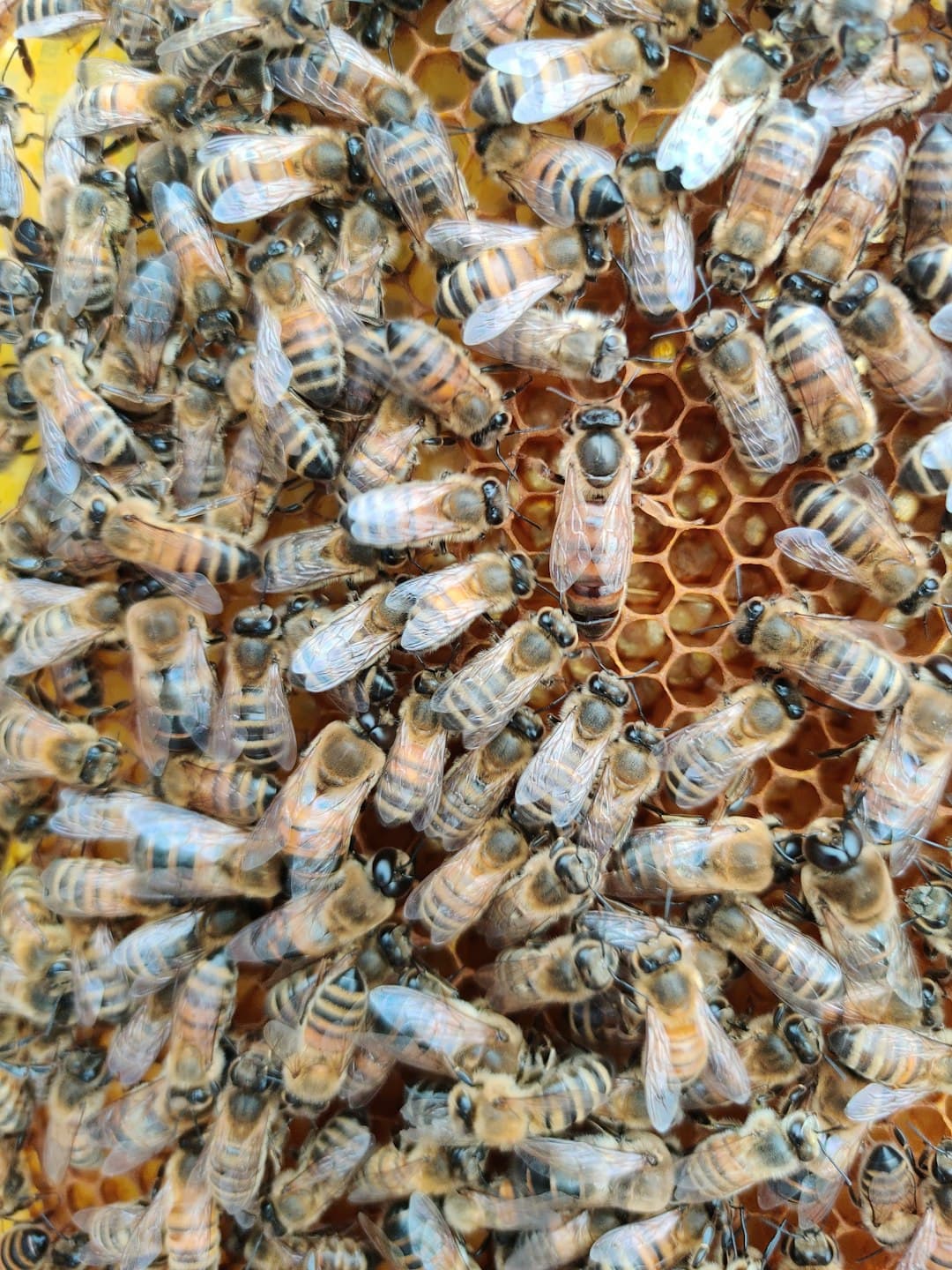
A honey bee colony isn't a crowd of individually self-interested insects — it behaves as a single reproductive unit, often called a superorganism. No single bee, including the queen, can survive alone for long. Understanding how the three castes divide the colony's work is the foundation for reading what's actually happening inside a hive.
The three castes
The queen is the colony's sole reproductive female. She is larger than other bees, with a longer abdomen built to hold and lay eggs, and in peak season she can lay well over a thousand eggs per day — more than her own body weight in eggs, daily. Beyond laying, she produces pheromones that signal her presence and condition to the rest of the colony; a healthy, actively-laying queen is the single biggest predictor of colony health, which is why "is there a laying queen" is the first question in almost every inspection.
Worker bees are also female, but with undeveloped ovaries under normal conditions, and they make up the overwhelming majority of the colony's population — tens of thousands in a strong summer hive. Workers perform every task other than egg-laying, and they do it in a predictable sequence tied to their age (sometimes called temporal polyethism):
- Young workers (roughly the first ~3 weeks of adult life) work inside the hive: cleaning cells, feeding larvae, tending the queen, building comb, and processing incoming nectar.
- Older workers transition to guarding the entrance and eventually to foraging — the most dangerous and short phase of a worker's life, typically lasting only a few weeks before she dies from the physical toll.
A worker's total lifespan is roughly 4-6 weeks during the active season, but workers reared in late fall (sometimes called "winter bees") live months longer, due to changes in their anatomy (like increased fat stores and yolk protein) and their job shifts to surviving winter as a cluster rather than foraging.
Drones are the colony's males, present mainly in spring and summer. Drones don't forage, don't defend the hive, and can't sting — their only role is mating with virgin queens (never their own colony's queen) at congregation areas away from the hive. Colonies typically expel remaining drones in autumn once mating season ends and resources need to be conserved for winter.
The brood cycle
All three castes develop through the same four stages — egg, larva, pupa, adult — but on different timelines, because caste is determined largely by feeding (all larvae get royal jelly early on, but a queen destined larva receives royal jelly exclusively throughout development, driving her distinct development and anatomy):
| Caste | Egg to emergence |
|---|---|
| Queen | ~16 days |
| Worker | ~21 days |
| Drone | ~24 days |
On an inspection, this is why a mix of eggs, uncapped (larval) brood, and capped (pupal) brood in a healthy pattern is reassuring: it shows a queen has been laying continuously and recently, not just at some point in the past.
The colony as a superorganism
Because no single bee can reproduce the colony's food stores, thermoregulation, or defense alone, colony-level behaviors emerge from many individuals acting on simple, shared cues — pheromones, tactile signals, and the waggle dance workers use to communicate the direction and distance of good forage. The colony collectively:
- Maintains brood-nest temperature within roughly a degree or two of 35°C (95°F), regardless of outside conditions, by clustering, fanning, or evaporating water.
- Stores honey and pollen as a buffered food supply against dearth and winter.
- Defends the colony disproportionately relative to any one bee's own survival — a stinging worker dies, but the colony benefits.
This is also why a colony can survive losing many individual bees but collapses quickly if it loses its queen and fails to raise a replacement — the superorganism's single point of reproductive failure is the queen, not any individual worker.
Sources & Further Reading
This lesson paraphrases general colony-biology material from the FAO's beekeeping guidance, the Wikibooks Beekeeping text, and USDA-ARS public-domain research summaries on honey bee biology.
- FAO. Good Beekeeping Practices for Sustainable Apiculture. 2021. Licensed under CC BY 3.0 IGO. https://www.fao.org/documents/card/en/c/cb4923en
- Wikibooks contributors. Beekeeping. Licensed under CC BY-SA 4.0. https://en.wikibooks.org/wiki/Beekeeping
- USDA Agricultural Research Service. Honey Bee Biology. US Government work, public domain. https://www.ars.usda.gov/
How many castes make up a honey bee colony?
What is the primary role of the queen in the colony?
Roughly how long does it take a worker bee egg to develop into an emerged adult?