
Lektion 6 av 6
Treatment-Free and Low-Intervention Approaches
What treatment-free beekeeping actually means, the cultural and mechanical tools it relies on, and the real trade-offs worth understanding before choosing it — presented neutrally, not as advocacy.
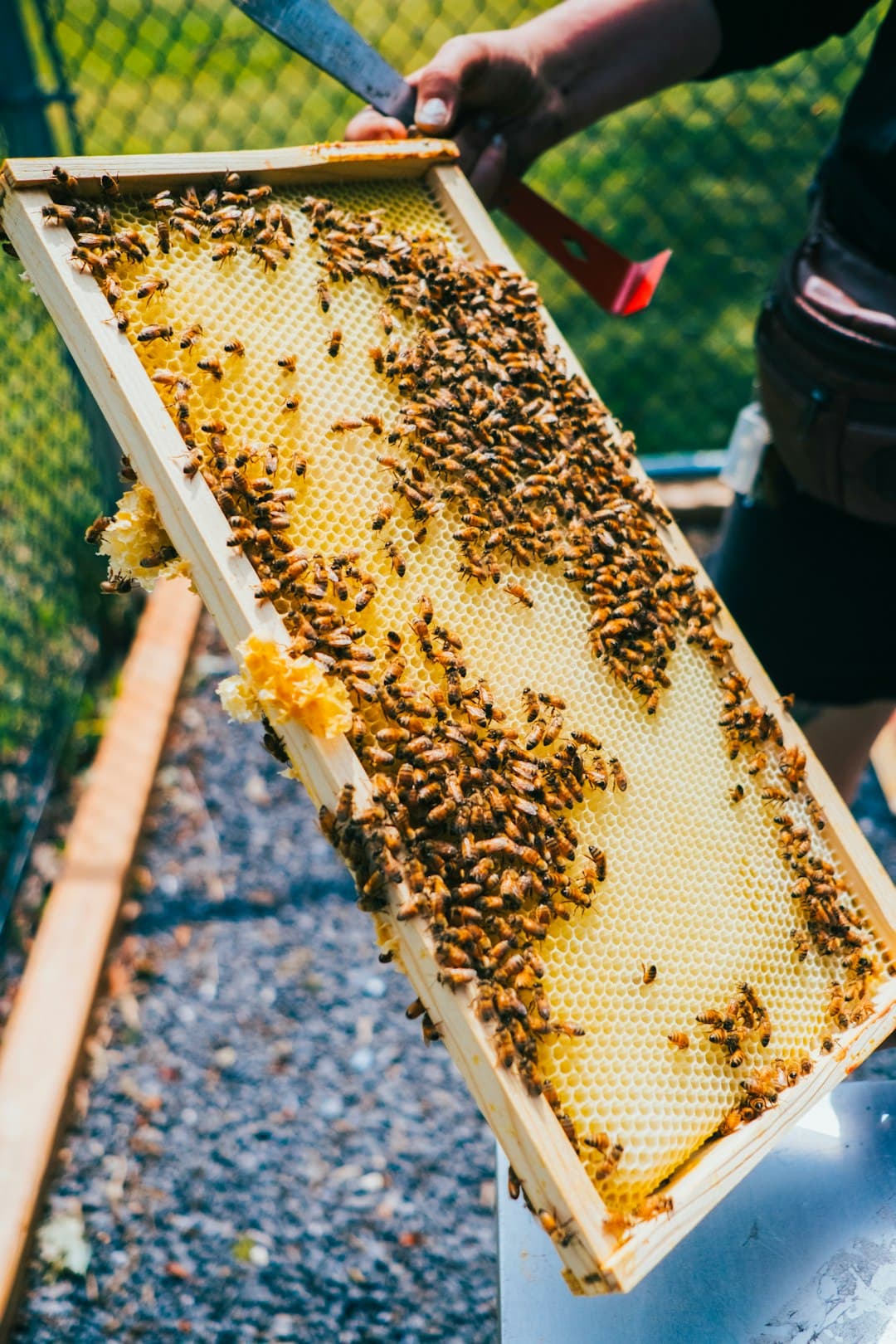
This is a genuinely debated area of beekeeping practice, and this lesson aims to present it neutrally: what the approach actually involves, the tools it relies on, and the real trade-offs — not an argument for or against it. Reasonable, experienced beekeepers land in different places on this question.
What "treatment-free" actually means
There's no single strict definition, and practice exists on a spectrum. At one end, some beekeepers simply prefer non-chemical (cultural and mechanical) controls over synthetic miticides but will still use organic acid treatments if monitoring shows a real problem — closer to "low-intervention" than strictly treatment-free. At the other end, some decline any Varroa treatment at all, chemical or organic, relying entirely on genetics and management practices, and accepting that some colonies will die as a result. Both ends of that spectrum, and positions in between, are actively practiced.
The resistance-breeding argument
The central premise behind stricter treatment-free approaches is a selective-breeding argument: if a beekeeper treats every colony that shows high mite loads, colonies with genuinely poor natural mite tolerance survive and reproduce right alongside more naturally resistant ones — treatment masks the genetic difference between them. Declining to treat allows natural selection to operate: colonies with better natural tolerance (through traits like hygienic behavior — workers detecting and removing mite-infested brood before mites reproduce further, briefly mentioned in the requeening lesson) survive and pass on those traits, while less-tolerant colonies don't. Over enough generations and colony turnover, the argument goes, the surviving population shifts toward greater natural resistance.
This is a real, recognized phenomenon in resistance breeding generally — it's the same principle Varroa-sensitive-hygiene (VSH) breeding programs use deliberately, just applied through natural colony losses rather than controlled breeding. Whether it works well enough, fast enough, to justify the colony losses along the way is exactly the part that's genuinely debated.
Cultural and mechanical tools
Several tools associated with treatment-free and low-intervention beekeeping aren't exclusive to it — many "conventional" beekeepers use some of these alongside chemical treatment as part of a broader IPM strategy (as covered in the advanced Varroa lesson earlier in this course):
- Screened bottom boards allow mites that fall off bees (through grooming or natural drop) to fall through and out of the hive entirely, rather than climbing back onto a bee from a solid floor — a modest, passive reduction in mite pressure with no chemical input.
- Brood breaks — a deliberate period with no capped brood present, achieved by caging the queen temporarily or allowing a colony to swarm/be split and requeen — deny mites their reproduction window, since Varroa reproduces specifically inside capped cells.
- Drone brood trapping — since mites preferentially reproduce in drone cells (which take longer to cap and offer a longer reproduction window), a frame that encourages excess drone comb can be removed and destroyed once capped, culling a disproportionate share of the mite population relative to the amount of brood sacrificed.
- Small-cell foundation (comb built on a smaller cell-size pattern than standard modern foundation) is sometimes cited as reducing mite reproduction, though the evidence for this specific claim is mixed and it remains one of the more contested tools in this space — worth knowing it exists and is discussed, without treating its effectiveness as settled.
Trade-offs worth understanding before choosing this path
- Higher expected colony losses, particularly in the early years of the approach or before resistant stock is established — a beekeeper choosing this path needs to genuinely accept losing colonies as part of the method's premise, not treat every loss as something gone wrong.
- Effects beyond your own apiary. Drones from untreated colonies mate with virgin queens at shared congregation areas regardless of whose apiary they came from, and mites can move between colonies via drift and robbing (covered in the seasonal-calendar and increase lessons). This means an individual beekeeper's treatment decisions can have consequences for nearby apiaries too — a real point of community tension in some areas, and worth discussing openly with beekeeping neighbors rather than deciding in isolation.
- It is not the same as neglect. Genuine treatment-free practice still involves active monitoring, requeening from resistant stock, and the cultural/mechanical tools above — declining chemical treatment while otherwise ignoring colony health is a different (and generally poorly-regarded) thing entirely.
Sources & Further Reading
This lesson paraphrases general IPM and cultural-control concepts from the FAO and Wikibooks, framed here specifically around the treatment-free/low-intervention end of that spectrum.
- FAO. Good Beekeeping Practices for Sustainable Apiculture. 2021. Licensed under CC BY 3.0 IGO. https://www.fao.org/documents/card/en/c/cb4923en
- Wikibooks contributors. Beekeeping. Licensed under CC BY-SA 4.0. https://en.wikibooks.org/wiki/Beekeeping
What is the core genetic argument behind treatment-free beekeeping's approach to mite resistance?
How does a 'brood break' interrupt the Varroa mite life cycle?
Which of these is a genuine, widely-acknowledged trade-off of treatment-free beekeeping worth weighing before adopting it?