
Lektion 3 av 6
Advanced Varroa and Disease Management
Comparing mite-monitoring methods, understanding treatment classes at a conceptual level, and building a resistance-management mindset into your seasonal routine.
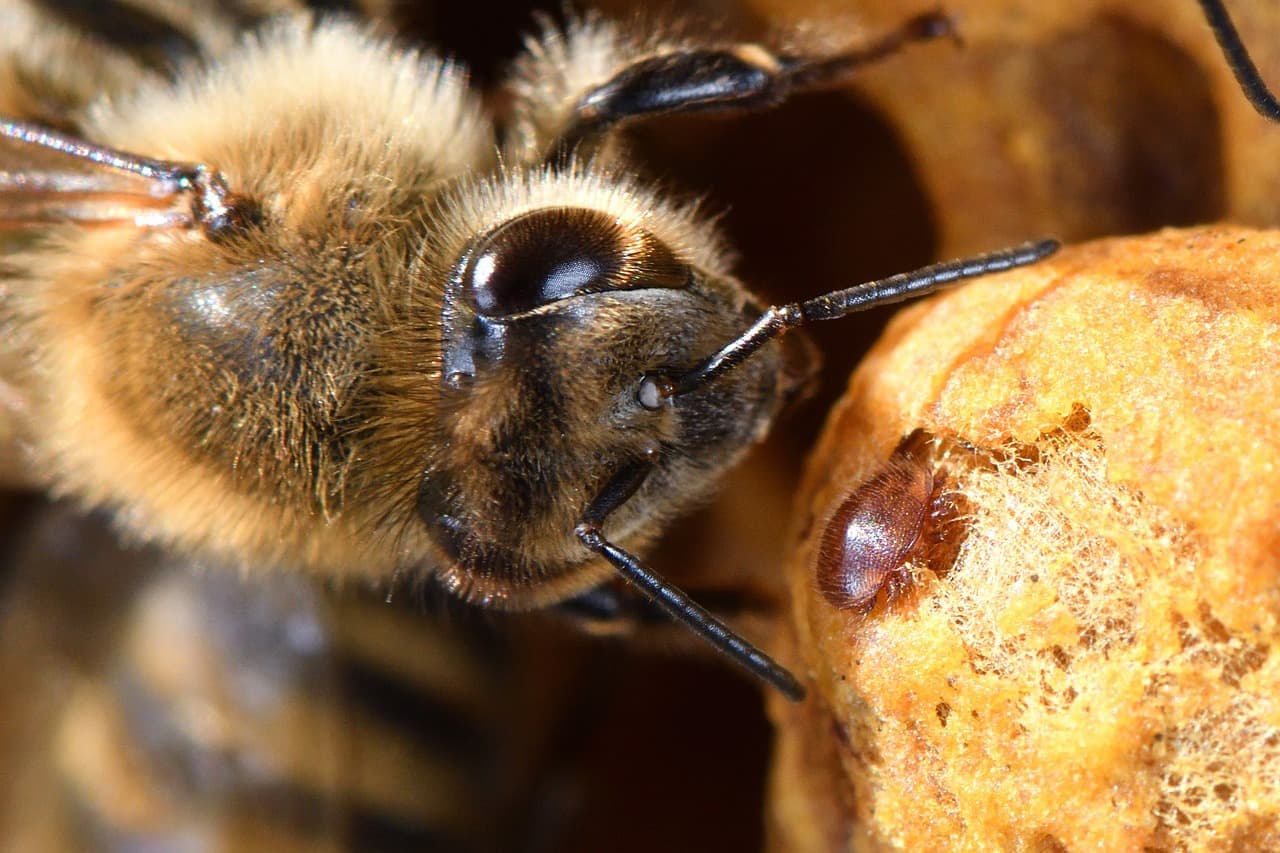
Fundamentals introduced Varroa as the most economically damaging honey bee pest and the basic IPM framework for managing it. This lesson goes one level deeper: comparing how monitoring is actually done, what the general categories of treatment are conceptually, and why which treatment you use matters as much as whether you treat at all.
Comparing monitoring methods
Every monitoring method trades some combination of accuracy, cost, and bee survival:
- Alcohol wash — a sample of roughly 300 bees (about half a cup) is shaken in alcohol, which dislodges essentially all mites present on those bees for an accurate count. It's widely considered the most accurate field method, but the sampled bees don't survive the process.
- Sugar roll — the same sample size is instead shaken in powdered sugar, which coats the bees and makes many (though not quite all) mites lose their grip and fall through a sieve for counting; the bees can then be returned to the hive alive. It's slightly less accurate than an alcohol wash but avoids killing bees, which matters more for a small hobbyist apiary than a commercial operation sampling many hives.
- Sticky board counts — a board coated in adhesive is placed under a screened bottom board to passively catch mites that fall off bees naturally over a set period (commonly 24-72 hours). It requires no bee sampling at all, but is the least precise method and is more useful for tracking a trend over time than for a single accurate snapshot.
None of these is universally "correct" — a beekeeper managing a handful of hobby hives might default to sugar rolls to avoid killing bees, while a larger operation may find alcohol washes' greater accuracy worth the trade-off across many colonies.
Treatment classes, conceptually
Registered Varroa treatments broadly fall into a few conceptual categories — the specifics of any given product (dosing, timing, temperature restrictions) change over time and by region, so always follow current label instructions or a local extension/apiary program rather than any single frozen source, but the categories themselves are stable:
- Organic acids (such as formic and oxalic acid) occur naturally in small amounts in honey already, and work by disrupting mites' physiology in ways bees tolerate better than mites do; they're commonly favored where residue-free treatment matters, though many have specific temperature windows for safe, effective use.
- Synthetic miticides are manufactured compounds engineered specifically to target mites; historically effective and widely used, but the specific class most prone to resistance developing over repeated, exclusive use in a given region.
- Non-chemical / cultural controls — covered in more depth in the treatment-free lesson — include things like drone brood removal and brood breaks, which reduce mite reproduction without any product application at all.
Why resistance management matters
Just as bacteria can develop antibiotic resistance and weeds can develop herbicide resistance, Varroa populations repeatedly exposed to the same single treatment class can gradually shift toward greater tolerance of it, as naturally more-resistant mites survive and reproduce disproportionately. The practical response is rotation: varying which treatment class is used from one treatment cycle to the next (rather than defaulting to the same product every time), and — per OMAFRA's biosecurity guidance — always applying registered treatments exactly per label instructions, since under-dosing in particular can accelerate resistance by killing susceptible mites while leaving more-tolerant ones to reproduce.
Building it into your seasonal routine
Tie monitoring into the seasonal calendar from Fundamentals rather than treating it as a separate task: a baseline count in spring, at least one more heading into the main summer buildup, and a critical late-summer count timed to catch levels before they threaten the winter bees being reared — the specific ~3% late-summer/early-fall threshold referenced in Fundamentals' seasonal-calendar lesson is exactly this kind of economic-threshold benchmark, not an arbitrary number.
Sources & Further Reading
This lesson paraphrases general monitoring-method and IPM guidance from the FAO and Wikibooks, and Ontario-specific biosecurity detail — verified directly from the source page — from OMAFRA, reproduced under the Open Government Licence – Ontario, which permits adaptation with attribution. The Honey Bee Health Coalition's Varroa management guide is linked for further reading only — its content is licensed CC BY-ND and has not been paraphrased or reproduced here.
- FAO. Good Beekeeping Practices for Sustainable Apiculture. 2021. Licensed under CC BY 3.0 IGO. https://www.fao.org/documents/card/en/c/cb4923en
- Wikibooks contributors. Beekeeping. Licensed under CC BY-SA 4.0. https://en.wikibooks.org/wiki/Beekeeping
- Government of Ontario / OMAFRA. Best Management and Biosecurity Practices for Beekeeping in Ontario. Licensed under the Open Government Licence – Ontario. https://www.ontario.ca/page/best-management-and-biosecurity-practices-beekeeping-ontario
- Honey Bee Health Coalition. Tools for Varroa Management. Licensed CC BY-ND — link only. https://honeybeehealthcoalition.org/varroa/
Which mite-monitoring method is generally considered the most accurate, at the cost of killing the sampled bees?
Why does resistance management matter in Varroa control?
What does treating based on an 'economic threshold' mean, versus a fixed calendar?