
Leçon 8 sur 11
Common Pests and Diseases
Varroa mites, American and European foulbrood, small hive beetle, Nosema, deformed wing virus, and the integrated pest management approach beekeepers use to monitor for and respond to colony health problems.
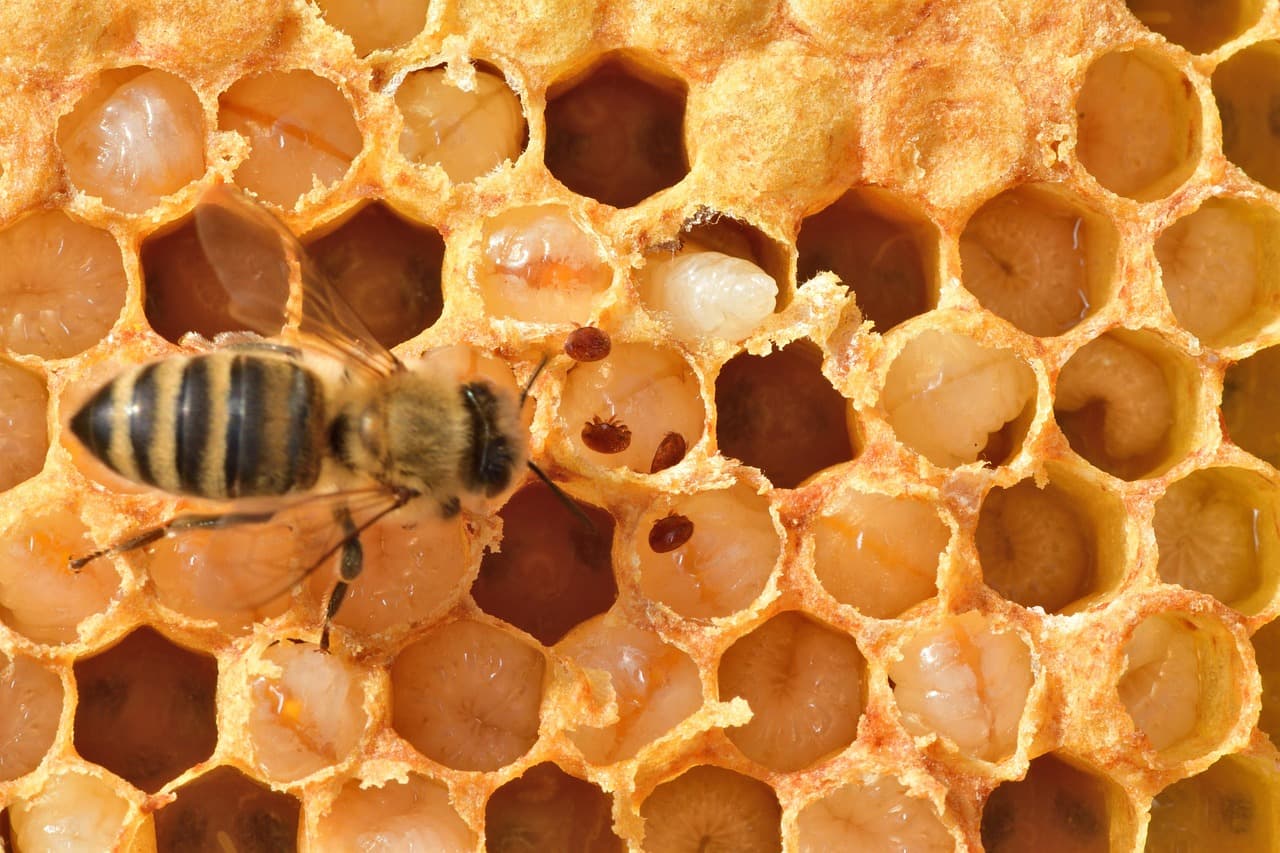
Every colony coexists with some level of pests and pathogens — the goal isn't a pest-free hive, it's keeping pressure low enough that the colony stays healthy and productive. This lesson covers the problems a beginner is most likely to encounter — starting with the two biggest, Varroa and foulbrood — plus a few more worth recognizing by name, and the general framework beekeepers use to manage them all.
Varroa destructor: the mite that changed beekeeping
Varroa is an external parasitic mite, visible to the naked eye as a small reddish-brown disc on an adult bee, that feeds on developing and adult honey bees. Its impact goes beyond direct parasitism: Varroa is also an efficient vector for several honey bee viruses, and colonies with high mite loads typically show much higher viral loads as a result — the combination is what makes Varroa the most economically damaging honey bee pest in most of the world today.
Monitoring matters more than any single treatment. Regular mite counts (commonly done via an alcohol wash or sugar roll of a bee sample) give an actual number to act on, rather than guessing. As covered in the seasonal-calendar lesson, a commonly cited target is treating early enough to keep levels below roughly 3% by late summer/early fall, since mite populations that are allowed to build up through the season are much harder to bring back down before the winter bees are reared. Specific treatment products, dosing, and timing change over time and by region — the Honey Bee Health Coalition's Tools for Varroa Management guide (linked below) is a widely-used, regularly updated reference for those specifics; consult it or a local extension/apiary program directly rather than relying on any single source frozen in time.
American and European foulbrood
American foulbrood (AFB) is a bacterial brood disease whose spores are extraordinarily persistent — they can remain viable in comb, equipment, and even honey for decades — which is why it's treated so seriously by regulators. Affected larvae die and decompose in a way that leaves cell cappings sunken, perforated, or discolored, sometimes with a distinctive odor. Because of the spores' persistence, most jurisdictions (Ontario included) require an AFB suspicion to be reported to an inspector rather than handled informally, and prohibit moving potentially contaminated equipment between colonies or apiaries.
European foulbrood (EFB) is a related but generally less severe bacterial brood disease that tends to appear during colony stress (dearth, overcrowding, or a weak colony), often clearing up on its own once conditions improve, though it can still require intervention and is also a reportable concern in regulated jurisdictions like Ontario.
Neither disease is something to self-diagnose confidently from a single photo — if brood looks abnormal in a way you can't otherwise explain, involve an experienced mentor or your local apiary inspector rather than guessing.
Other pests and health issues to know
Varroa and foulbrood get the most attention, but a beginner should at least recognize a few other problems by name.
Small hive beetle (Aethina tumida) is a small, dark scavenging beetle whose larvae tunnel through comb, eating brood, pollen, and honey, and defecating in it in a way that causes stored honey to ferment and run — beekeepers often describe a heavily infested hive as "slimed." It's primarily a problem in warm, humid climates, since beetle larvae pupate in soil and don't tolerate cold winters well, so pressure is much higher in warmer regions of North America than in most of Canada. A strong, well-ventilated colony with a beekeeper-sized entrance it can defend is the best first line of defense; beetle traps (oil or diatomaceous-earth based) and reducing unused hive space also help where beetles are established.
Nosema is a microsporidian gut parasite (two species affect honey bees, Nosema apis and the now more common Nosema ceranae) that infects the midgut lining of adult bees and interferes with their ability to digest food and absorb nutrients, shortening their lifespan and reducing the colony's overall foraging strength. N. apis is classically associated with visible dysentery — streaking of feces on and around the hive, especially after bees have been confined by cold weather — while N. ceranae infections are often less visibly dramatic but can still quietly weaken a colony. Because symptoms overlap with other problems, confirming Nosema really requires a microscope; good ventilation, hive hygiene, and periodically replacing old comb all help keep pressure low.
Deformed wing virus (DWV) is one of the most common honey bee viruses, and the one most directly tied to Varroa: the mite doesn't just spread DWV between bees, it also amplifies how much virus a bee carries by injecting it directly into the bee's body as it feeds. Bees that develop as pupae under heavy viral load can emerge with visibly shriveled, deformed wings and a bloated or shortened abdomen, unable to fly — a hive with a noticeable number of these bees crawling near the entrance is a strong sign of a serious, established Varroa problem, not just a virus problem on its own. This is why Varroa control is described as the single most effective way to manage DWV in a colony.
Beyond these, you'll also hear about wax moths (which damage stored comb, especially in weak colonies or unused equipment left unprotected) and chalkbrood (a fungal brood disease that mummifies larvae, usually tied to damp, poorly ventilated conditions). Neither is typically as serious as Varroa, foulbrood, small hive beetle, or Nosema, but both are worth recognizing by name as you get more hive-inspection experience.
The integrated pest management (IPM) approach
IPM is the general framework beekeepers and agricultural programs use across pest problems, not just Varroa:
- Monitor first. Base decisions on actual counts or observed signs, not a fixed calendar applied regardless of real conditions.
- Use cultural and mechanical controls where practical — for Varroa, this includes things like drone brood removal (mites preferentially reproduce in drone cells) or requeening with mite-resistant stock; more broadly, good hive hygiene, equipment sterilization between colonies, and preventing robbing (bees from other colonies raiding a weak hive, which can also spread disease) all reduce pressure without chemical input.
- Treat when monitoring shows it's needed, using legally registered products applied exactly per label instructions — over-treating "just in case" wastes resources and can contribute to resistance, while under-treating when data shows a real problem risks colony loss.
- Reassess. Treatment isn't a one-time fix — recheck mite counts or brood health afterward to confirm it worked.
Ontario's biosecurity guidance adds a few concrete, broadly-applicable habits worth adopting regardless of jurisdiction: avoid disturbing colonies during a nectar dearth (when robbing risk is highest), store any "deadout" equipment from a collapsed colony somewhere bees genuinely can't access it until it's been assessed, and use disposable gloves (nitrile, rather than reusable leather) between colonies, since reusable gloves can carry pathogens from one hive to the next.
Sources & Further Reading
This lesson paraphrases general pest/disease and IPM guidance — including on small hive beetle, Nosema, and deformed wing virus — from the FAO and Wikibooks, and Ontario-specific regulatory and biosecurity detail — verified directly from the source pages — from OMAFRA, reproduced under the Open Government Licence – Ontario, which permits adaptation with attribution. The Honey Bee Health Coalition's Varroa management guide is linked for further reading only — its content is licensed CC BY-ND and has not been paraphrased or reproduced here.
- FAO. Good Beekeeping Practices for Sustainable Apiculture. 2021. Licensed under CC BY 3.0 IGO. https://www.fao.org/documents/card/en/c/cb4923en
- Wikibooks contributors. Beekeeping. Licensed under CC BY-SA 4.0. https://en.wikibooks.org/wiki/Beekeeping
- Government of Ontario / OMAFRA. Summary of Ontario Beekeeping Regulations. Licensed under the Open Government Licence – Ontario. https://www.ontario.ca/page/summary-ontario-beekeeping-regulations
- Government of Ontario / OMAFRA. Best Management and Biosecurity Practices for Beekeeping in Ontario. Licensed under the Open Government Licence – Ontario. https://www.ontario.ca/page/best-management-and-biosecurity-practices-beekeeping-ontario
- Honey Bee Health Coalition. Tools for Varroa Management. Licensed CC BY-ND — link only. https://honeybeehealthcoalition.org/varroa/
What does Varroa destructor primarily do to a honey bee colony?
In most regulated jurisdictions, what is the general rule if a beekeeper suspects American foulbrood in a colony?
What does 'integrated pest management' (IPM) mean in a beekeeping context?
Why does controlling Varroa also help control deformed wing virus (DWV)?