
Lección 4 de 11
Getting Your First Bees
Packages, nucs, and swarms compared, how to site an apiary, and what to check with your local regulator before your bees arrive.
Once you've decided to start keeping bees, the first concrete steps are choosing how you'll acquire your colony, picking a site for it, and — depending on where you live — completing whatever registration your local regulator requires before the bees arrive.
Three ways to start a colony
Packages are a screened box of loose worker bees (commonly around 1.4-2 kg, roughly 10,000-15,000 bees) with a separately caged queen, shipped or picked up with no comb at all. They're widely available, often the cheapest entry point, and let you choose your own equipment from scratch — but the colony has to draw all its own comb and build up population from nothing, so it takes longer to become productive and is more vulnerable early on.
Nucleus colonies ("nucs") are small, already-established colonies — typically 4-5 frames of drawn comb complete with a laying queen, brood in multiple stages, and some food stores, lifted directly into your hive body. Because so much of the early work is already done, nucs build up faster and more reliably than packages, which is why many beginner programs and mentors recommend them for a first colony — though they usually cost more and are less widely available than packages.
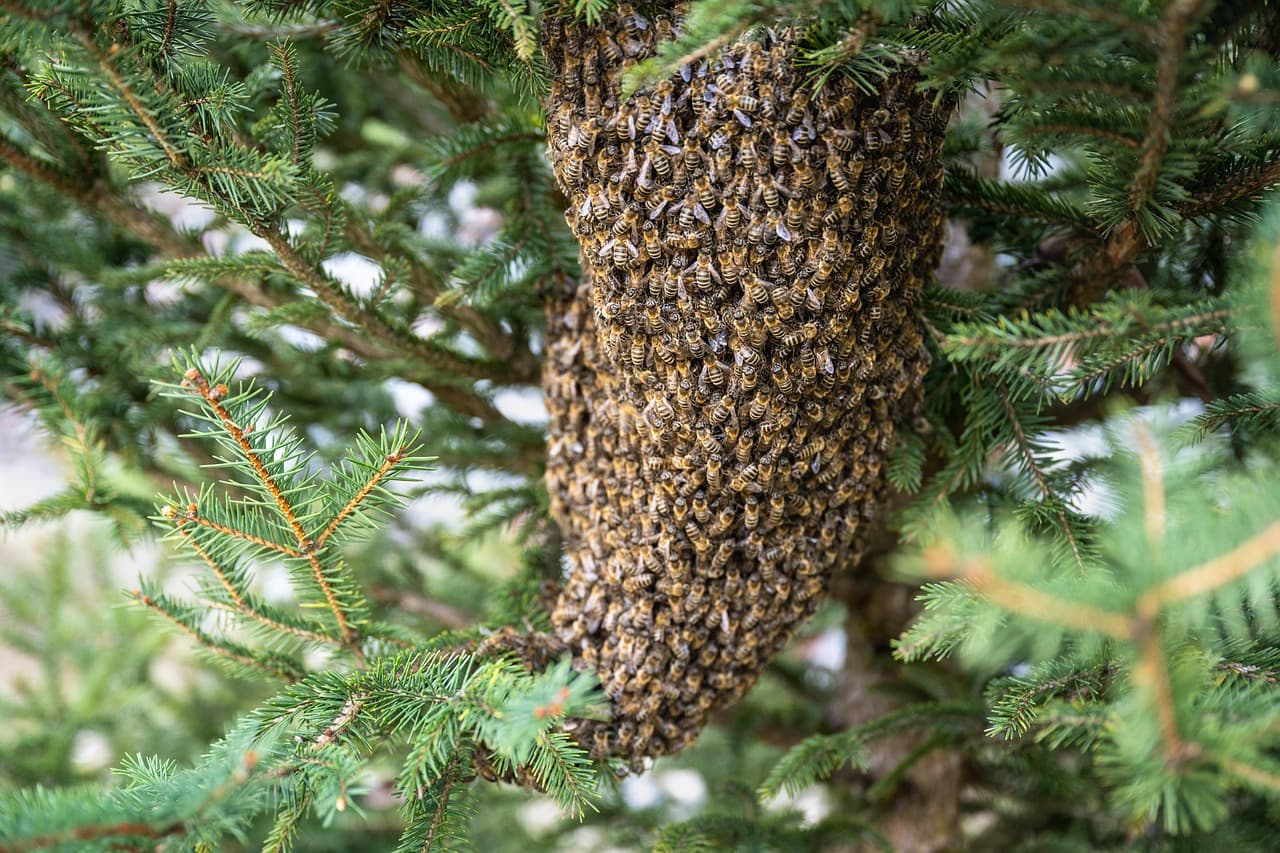
Swarms are colonies (or portions of colonies) captured after they've left their original hive to find a new home. A captured swarm can be a fine, no-cost way to start — swarms are often surprisingly calm and motivated to draw comb quickly — but you generally can't know the swarm's health history, mite load, or genetics, and swarm availability depends entirely on timing and luck rather than being something you can plan around.
For a first colony, a nuc from a reputable local, registered beekeeper is usually the most forgiving option: known genetics, known health status, and a running start.
Siting your apiary
Where you place your hive(s) matters as much as what's inside them:
- Morning sun, afternoon shade where possible — morning sun encourages bees to start foraging earlier in the day; too much hot afternoon sun in warm climates can stress the colony.
- Wind protection — a hedge, fence, or building on the prevailing-wind side reduces heat loss and makes the entrance easier for bees to defend and navigate.
- Water source — bees need water daily for cooling and diluting stores; a nearby shallow water source (with landing material like stones or floating wood, so bees don't drown) keeps them from bothering a neighbor's pool or birdbath instead.
- Forage access — a reasonable variety of flowering plants within a few kilometres; bees will forage widely, but a diverse local landscape reduces stress during dearth periods.
- Neighbors and traffic — orient entrances away from walkways and property lines where possible, and consider a flyway barrier (a fence or hedge a couple of metres from the hive) to force bees to gain altitude quickly rather than crossing at head height.
Registration and regulation
Most beekeeping jurisdictions require some form of registration before you can legally keep bees, along with siting rules (minimum distances from neighboring dwellings or roads) and a duty to report notifiable pests or diseases to the appropriate authority. Exactly what's required — whether registration exists at all, what it costs, what the setback distances are, which diseases are reportable — varies enormously by country, state, or province, so this genuinely isn't an area to guess at from general knowledge or from what a beekeeper in a different region tells you.
One concrete example, not a global standard: in Ontario, Canada, anyone who owns or possesses honey bees or used beekeeping equipment must hold a valid registration certificate from the provincial Apiary Program, hives must sit at least 30 metres from a neighboring dwelling's property line and 10 metres from a roadway, and suspected pests or diseases — including American and European foulbrood — must be reported to a provincial inspector. Treat this as a sense of the kind of rule you might encounter, not as a number that applies to you.
Before your bees arrive, find your own country's, state's, or province's agriculture or apiary authority and confirm three things: whether registration is required and how to complete it, what (if any) minimum setback distances apply to your specific site, and what pests or diseases you're obligated to report if you find them.
Sources & Further Reading
This lesson paraphrases general acquisition and siting guidance from the FAO and Wikibooks. The Ontario example is regulatory detail verified directly from the source page, reproduced under the Open Government Licence – Ontario, which permits adaptation with attribution — included as one illustrative case, not as guidance that applies outside that province.
- FAO. Good Beekeeping Practices for Sustainable Apiculture. 2021. Licensed under CC BY 3.0 IGO. https://www.fao.org/documents/card/en/c/cb4923en
- Wikibooks contributors. Beekeeping. Licensed under CC BY-SA 4.0. https://en.wikibooks.org/wiki/Beekeeping
- Government of Ontario / OMAFRA. Summary of Ontario Beekeeping Regulations. Licensed under the Open Government Licence – Ontario. https://www.ontario.ca/page/summary-ontario-beekeeping-regulations
What is the main practical difference between a nuc and a package?
What should a new beekeeper do before acquiring bees, regardless of where they live?
When is the best general time to install a new package or nuc in a temperate climate?