
Leçon 4 sur 6
Maximizing Honey Production
Why colony strength concentrates yield, timing supers ahead of the flow, the value of drawn comb, and why swarm prevention is also a production strategy.
Fundamentals covered the mechanics of harvesting — knowing when honey is ready and how extraction works. This lesson is about the management decisions that determine how much surplus there is to harvest in the first place.
Colony strength is the biggest single lever
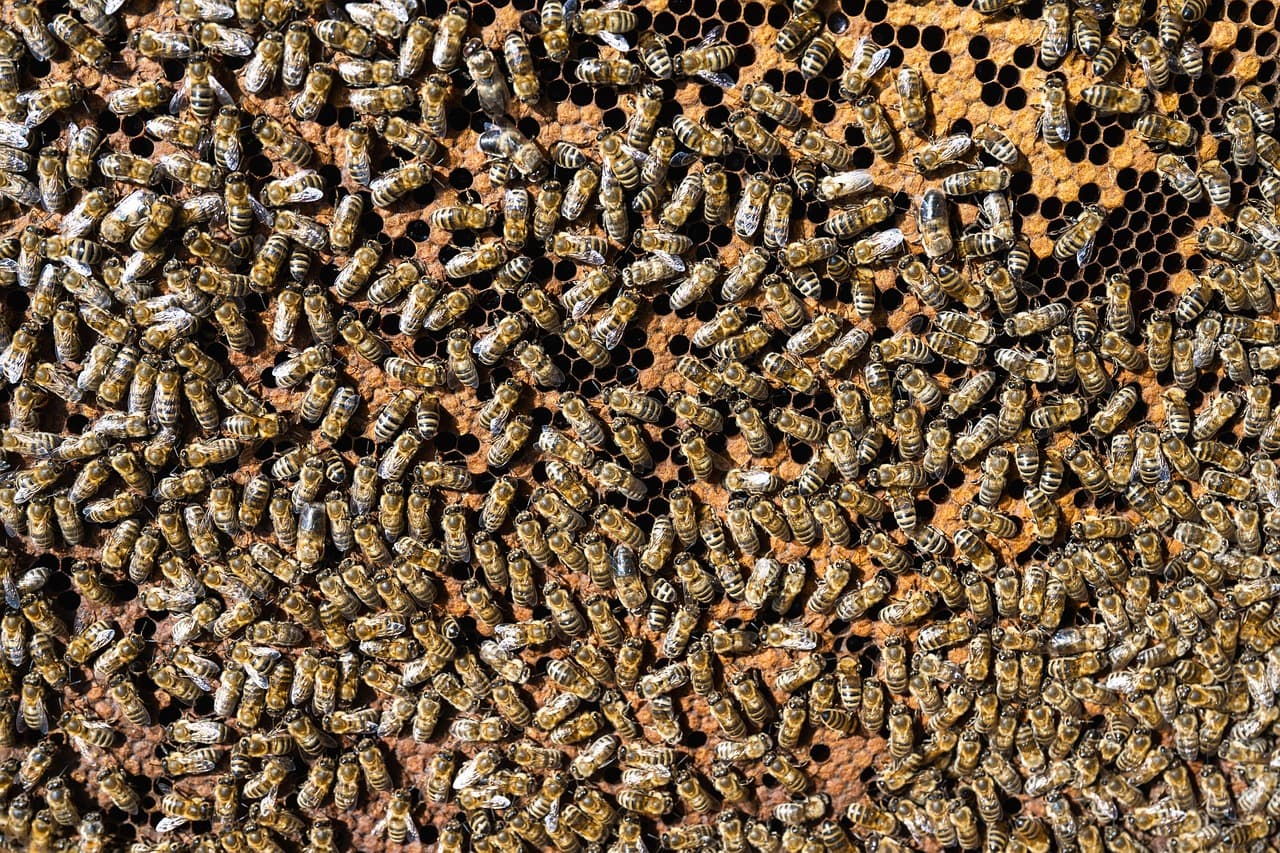
Every colony carries a baseline overhead regardless of its size: bees dedicated to brood care, nest temperature regulation, and defense that don't contribute directly to foraging surplus. That overhead doesn't scale down proportionally in a smaller colony — a weak colony still needs to defend its entrance and keep its (smaller) brood nest warm, leaving proportionally fewer bees free to forage. The practical consequence is that one strong colony often outproduces two weaker colonies with the same combined bee count, because the strong colony spreads its fixed overhead over a larger foraging workforce. This is the core argument for the requeening and disease-management practices covered earlier in this course: keeping every colony as strong and healthy as possible isn't just about colony survival, it's a direct honey-production strategy.
Timing supers ahead of the flow
Adding honey supers reactively — only once a colony is visibly out of room — creates two problems at once: it risks triggering the swarm preparations covered in Fundamentals, and it means bees may arrive at the start of a strong nectar flow with nowhere immediate to put it, which can dampen foraging enthusiasm ("bearding" and reduced flight activity are common signs of a congested, under-supered colony). Experienced beekeepers generally add supers a step ahead of demonstrated need, watching the calendar for an expected flow rather than waiting for obvious crowding.
Why drawn comb is worth protecting
Comb takes significant energy for bees to build from foundation — by some measures, drawing a full frame of new comb costs a colony a meaningful multiple of the energy required to simply fill an already-drawn frame with honey. This is why, as covered in the harvest lesson from Fundamentals, returning extracted frames (with their comb structure intact) to the hive rather than discarding them matters so much: a beekeeper who builds up a stock of drawn comb over successive seasons gives every future colony a running start, letting incoming nectar go straight to storage instead of comb-building.
The queen excluder trade-off
A queen excluder keeps the queen (and therefore brood) out of honey supers, which matters for harvest quality — nobody wants brood cells mixed into extraction frames. The trade-off some beekeepers report is a slight reduction in how readily foragers pass through the excluder into supers compared to an unrestricted hive, sometimes nicknamed a "honey excluder" by its critics. Whether that trade-off is worth it is genuinely debated among experienced beekeepers; a common middle ground is leaving the excluder off during the earliest part of a flow (when the colony is naturally focused on the brood nest anyway) and adding it once supers are already being actively used.
Forage and hive placement
Beyond colony management, where (and sometimes when) a hive is placed affects yield directly — a hive sited near a strong, sustained bloom will out-produce an identical hive in a forage-poor location, which is why some larger operations move hives seasonally to track blooming crops or wildflower flows (a practice commonly called migratory beekeeping at commercial scale). For a hobbyist, the more practical version of the same principle is simply weighing forage access seriously when siting an apiary in the first place, as covered in the first-bees lesson in Fundamentals.
Sources & Further Reading
This lesson paraphrases general production-management guidance from the FAO, Wikibooks, and USDA-ARS public-domain material.
- FAO. Good Beekeeping Practices for Sustainable Apiculture. 2021. Licensed under CC BY 3.0 IGO. https://www.fao.org/documents/card/en/c/cb4923en
- Wikibooks contributors. Beekeeping. Licensed under CC BY-SA 4.0. https://en.wikibooks.org/wiki/Beekeeping
- USDA Agricultural Research Service. Honey Bee Biology. US Government work, public domain. https://www.ars.usda.gov/
Why can one strong colony often produce more surplus honey than two weaker colonies with the same total bee count?
Why do experienced beekeepers typically add honey supers before a colony visibly needs the space?
Why does a swarm event during the main nectar flow specifically hurt honey yield?