
Lektion 2 von 5
Record-Keeping for Compliance and Claims
What to record and why, what 'audit-ready' actually means, and how USDA's ELAP program illustrates why documentation has to happen as you go, not after the fact.
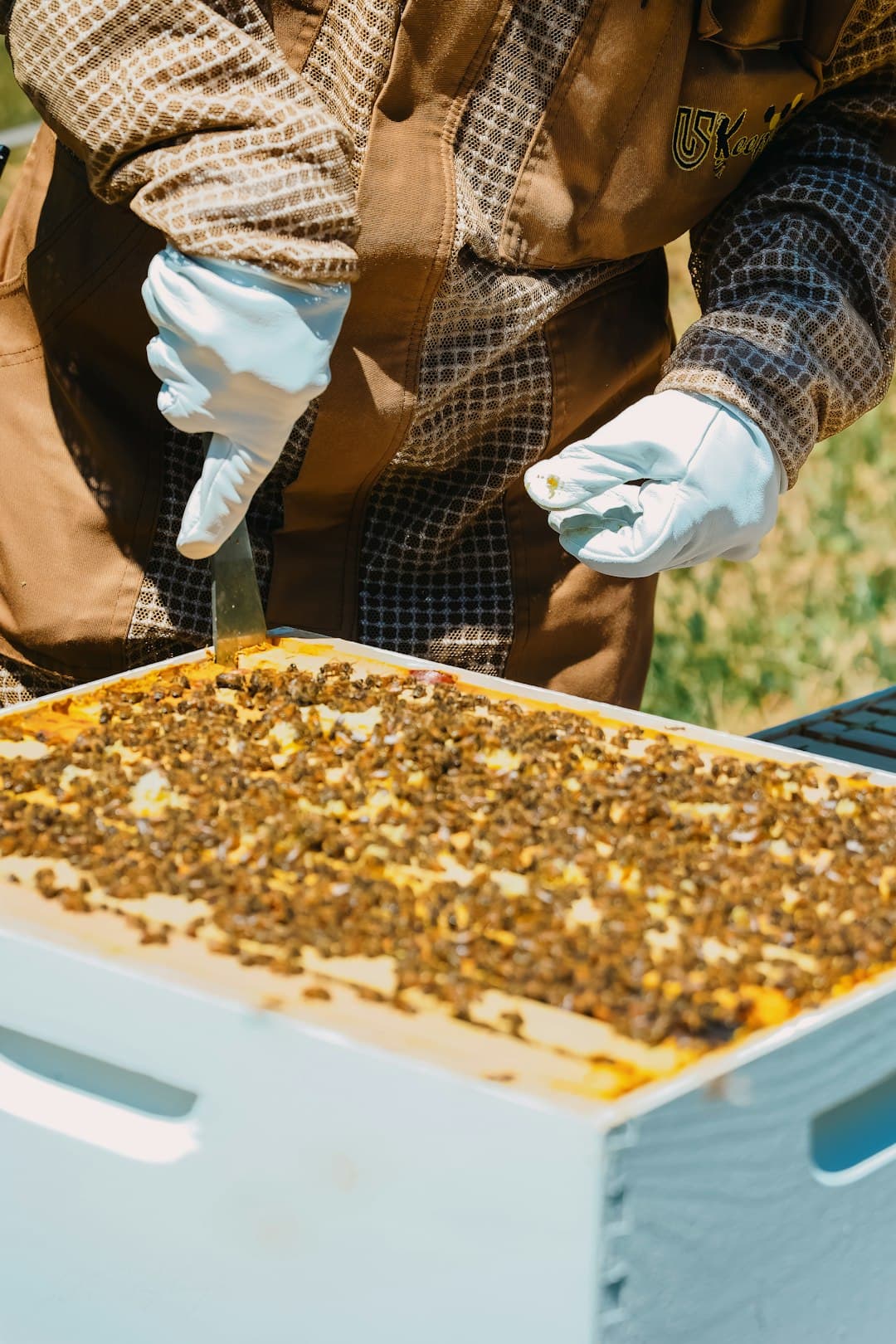
Fundamentals and Intermediate both touched on record-keeping in passing — logging inspections, tracking treatments for resistance management, noting harvest weights. This lesson treats it as its own discipline, because good records aren't just a management convenience once an operation grows: they're often the entire difference between a processable claim and a denied one.
What to actually record
- Inspection findings — date, what was observed (queen status, brood pattern, stores, any pest/disease signs), and what action (if any) was taken.
- Treatments — product, date, dose, and application method for any pest or disease treatment, which also directly supports the resistance-management rotation covered in the advanced Varroa lesson from Intermediate.
- Feeding — dates and quantities of syrup or supplement fed, useful both for understanding a colony's condition history and for separating fed sugar from harvested honey if that distinction ever matters.
- Harvests — date, yield, and which colony/apiary a batch came from, which is also the foundation the traceability lesson builds on.
- Losses — date discovered, suspected cause, and colony/hive identifier, ideally with photos if a loss is significant enough to matter for a claim.
- Weather and notable events — unusual weather, chemical exposure incidents nearby, or anything else that might explain a loss later, since the cause of a loss is often only reconstructable from what was actually recorded at the time.
What "audit-ready" actually means
Audit-ready records share three qualities: they're dated, specific (not "checked hives, all fine" but which hives, what was observed), and contemporaneous — written down close to when the event happened, not reconstructed from memory weeks or months later when a claim or inspection suddenly requires them. Records built this way are both more reliable for your own management decisions and more credible to anyone — an inspector, an insurer, a disaster-assistance program — who might need to review them.
A concrete example: USDA's ELAP program
The US Emergency Assistance for Livestock, Honeybees, and Farm-Raised Fish Program (ELAP), administered by USDA's Farm Service Agency, illustrates why this discipline matters concretely, not just abstractly. ELAP provides financial assistance for honeybee colony losses, but only losses in excess of a "normal mortality" baseline — under the Working Families Tax Cuts Act, that baseline is set at 15% for honeybee colony losses starting with the 2026 program year, meaning a beekeeper has to demonstrate losses beyond what's considered ordinary attrition, not simply that some bees died. Eligible honeybees are specifically those kept in a managed hive for honey production, pollination, or breeding — not wild or feral colonies.
Two requirements make the record-keeping connection explicit:
- Annual registration — beekeepers must register their hives with FSA before December 31 each year to remain eligible for that program year.
- Documentation of losses and cause — acceptable evidence includes things like purchase records, feed and water receipts, and other supporting documentation of both the loss itself and the condition that caused it.
A beekeeper who's been keeping dated, specific records as described above already has most of what ELAP (or an equivalent program) would ask for; a beekeeper reconstructing records after a loss event is trying to build a case from memory, under time pressure, after the fact.
Beyond the US
ELAP is a US-specific program, but the underlying pattern generalizes: most countries and many provinces or states have some form of agricultural disaster assistance, and virtually all of them require documented, dated evidence of losses and their cause rather than taking a beekeeper's word alone. Beekeepers outside the US should check their own country's or province's equivalent agricultural support programs directly — the specific eligibility thresholds and documentation requirements will differ, but the core principle (keep records as you go, not after) applies everywhere.
Sources & Further Reading
This lesson paraphrases general record-keeping guidance from the FAO and Wikibooks, and cites verified, current ELAP program specifics directly from the USDA Farm Service Agency's own fact sheet, a US government work in the public domain.
- FAO. Good Beekeeping Practices for Sustainable Apiculture. 2021. Licensed under CC BY 3.0 IGO. https://www.fao.org/documents/card/en/c/cb4923en
- Wikibooks contributors. Beekeeping. Licensed under CC BY-SA 4.0. https://en.wikibooks.org/wiki/Beekeeping
- USDA Farm Service Agency. ELAP: Honeybee Assistance Fact Sheet. US Government work, public domain. https://www.fsa.usda.gov/resources/programs/emergency-assistance-livestock-honeybees-farm-raised-fish-elap
As of the 2026 ELAP program year, roughly what colony-loss rate must a US beekeeper's losses exceed before they're eligible for ELAP compensation?
Which US agency administers ELAP?
What does 'audit-ready' record-keeping generally mean?