
Lektion 1 von 5
Pricing and Selling Your Honey
Cost-plus vs. market vs. value-based pricing, the selling channels available to a small producer, and why varietal or specialty honey commands a premium.
Fundamentals and Intermediate covered producing honey well. This course turns to what happens once you actually have surplus to sell — starting with the two decisions every seller faces first: what to charge, and where to sell it.
Three ways to think about pricing
- Cost-plus starts from your own numbers — equipment amortization, bees, treatments, feed, packaging, and your own labor time (a cost many new sellers underestimate or skip entirely — covered in more depth in the apiary-economics lesson) — and adds a margin on top. It's the most defensible approach if you ever need to justify a price, but it can undervalue a genuinely differentiated product.
- Market-based pricing looks at what comparable local honey actually sells for and prices near that range. It's a reasonable starting point for a new seller with no track record of their own, but it caps your price at whatever the local market has already normalized, regardless of your own product's quality.
- Value-based pricing starts from what a specific product's qualities let the market bear — a rare varietal source, a compelling traceability story (covered in the next lesson), organic or treatment-free practices, or simply an established local reputation. Well-differentiated small-batch honey commonly prices well above generic-blend market rates using this approach.
Most small sellers end up blending all three: a cost-plus floor they won't price below, informed by what the local market is already doing, adjusted upward for anything that genuinely differentiates their product.
Why varietal honey commands a premium
Varietal (or "monofloral") honey comes predominantly from one nectar source — clover, basswood, buckwheat, orange blossom, and similar — collected during a period when that plant dominates the local bloom. Because it comes from a describable, traceable source, it has a distinct flavor and story that a generic multi-source wildflower blend, by definition, cannot offer. This differentiation is a large part of why varietal honey often commands a meaningfully higher price than blended honey of otherwise similar quality — and it's a lever available to any beekeeper who tracks which apiary or timeframe a batch came from (again, covered further in the traceability lesson).
Beyond varietal sourcing, value-added formats — comb honey (sold still in the wax), creamed or whipped honey, and infused honey (with fruit, herbs, or spices) — are additional ways small producers differentiate from commodity liquid honey and price accordingly.
Selling channels
- Farm-gate or roadside sales — the simplest channel, selling directly from your own property; typically the least regulatory overhead but also the smallest potential customer base.
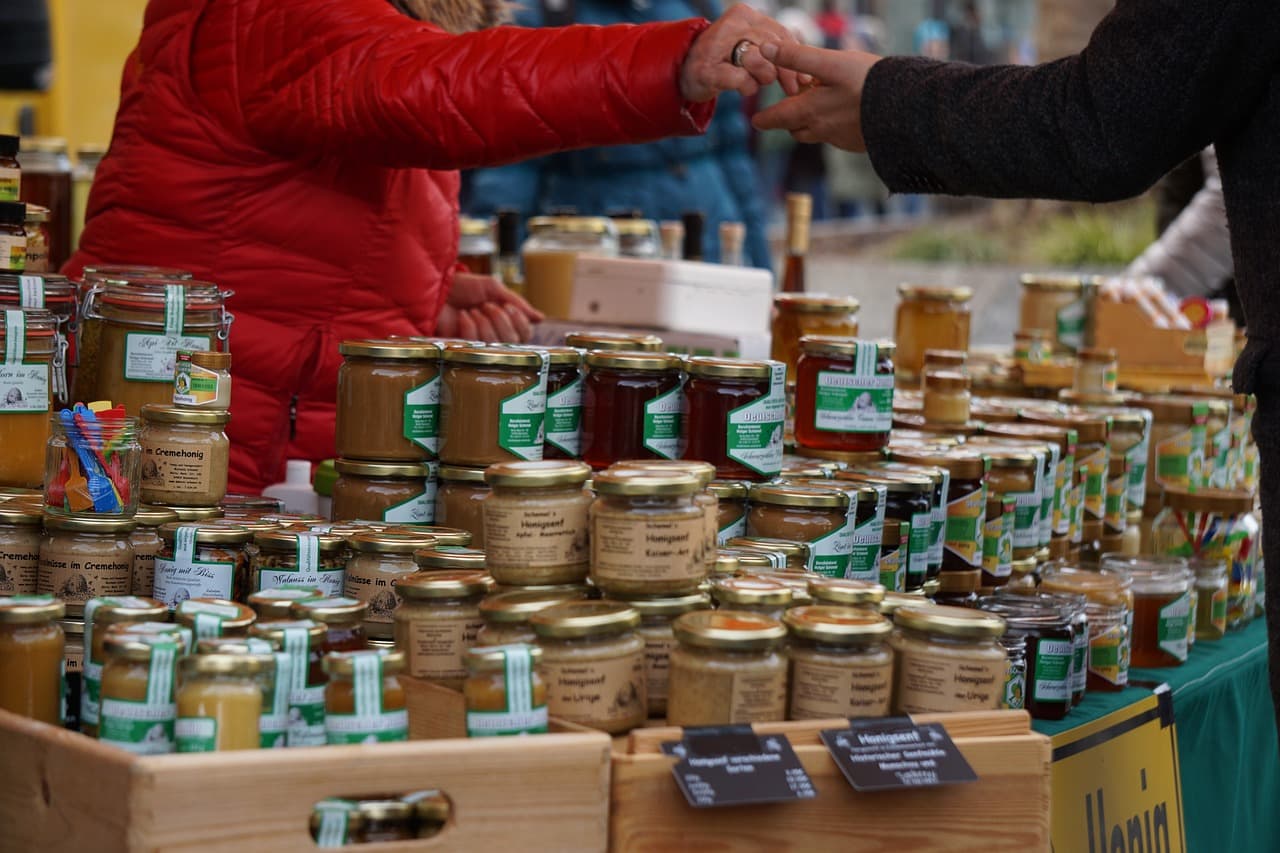
- Farmers markets — direct customer contact and typically favorable margins, at the cost of your own time attending regularly.
- Local retail and small wholesale — placing honey in local shops or specialty stores extends reach without requiring your own ongoing time at a stall, generally at a lower per-jar margin since the retailer takes a cut.
- Direct online sales — reaches beyond your immediate area, but usually requires more marketing effort and has its own packaging/shipping considerations for a product as heavy and leak-prone as honey.
- Pre-sell or subscription models — some small producers sell a season's honey (or a share of the harvest) in advance, which can smooth cash flow but commits you to delivering even in a lower-yield year.
A note on regulation
Almost every jurisdiction has some combination of food-labeling requirements (accurate net weight, producer identification) and food-safety handling rules that apply once you're selling honey rather than just keeping it for yourself — and exactly what those rules require varies significantly by country, state, or province. This is genuinely not an area to guess at from general knowledge; check your own local food-safety and agriculture authority directly before selling.
Sources & Further Reading
This lesson paraphrases general pricing-strategy and market-channel guidance from the FAO and Wikibooks.
- FAO. Good Beekeeping Practices for Sustainable Apiculture. 2021. Licensed under CC BY 3.0 IGO. https://www.fao.org/documents/card/en/c/cb4923en
- Wikibooks contributors. Beekeeping. Licensed under CC BY-SA 4.0. https://en.wikibooks.org/wiki/Beekeeping
What's the core difference between cost-plus and value-based pricing?
Why might a single-source (varietal) honey command a higher price than a generic wildflower blend?
Why is it important to check local labeling and food-safety regulations before selling honey, rather than assuming a standard practice applies everywhere?