
Lektion 4 von 4
Defensive Genetics and Working Safely in Warmer Regions
A factual, safety-focused look at Africanized honey bees where they're present, and why regionally-adapted stock matters more broadly in warm-climate beekeeping.
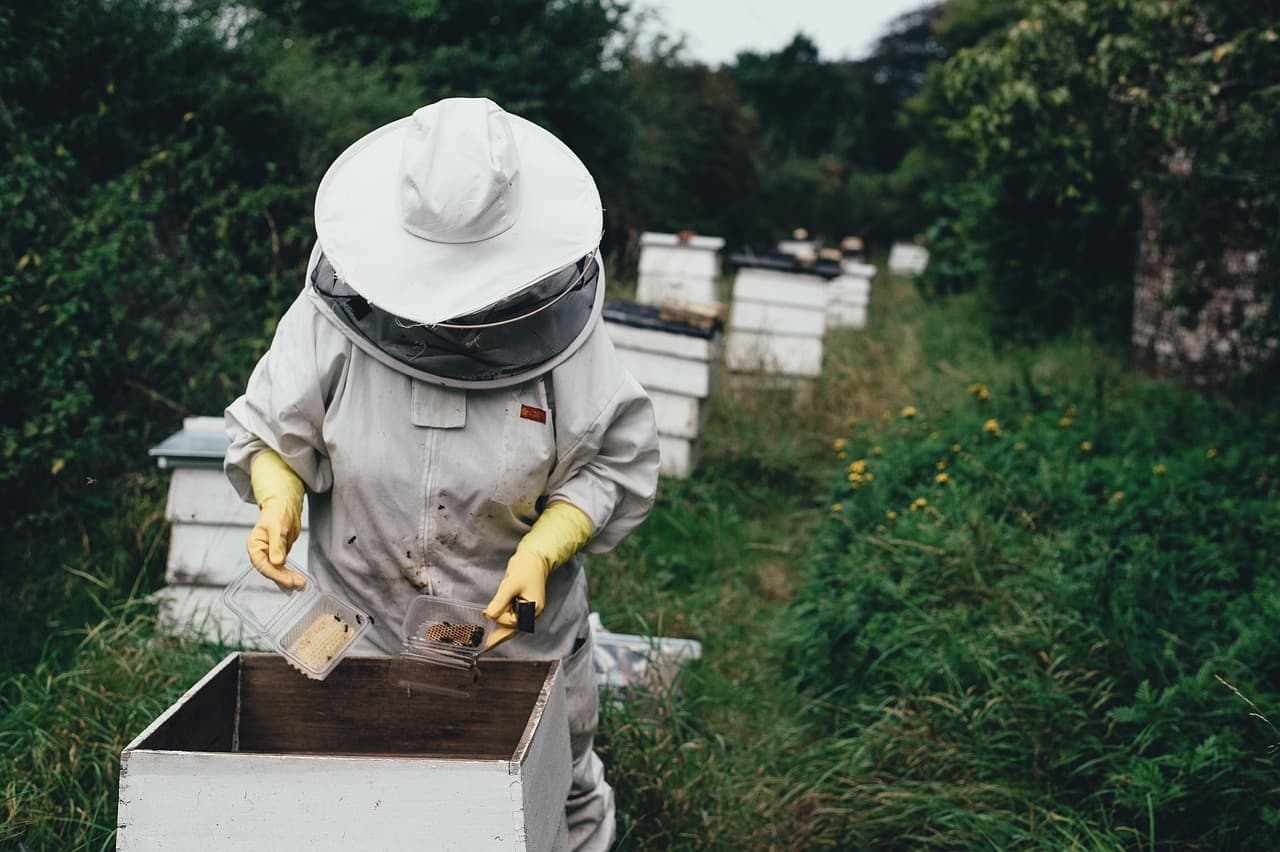
This lesson covers a real, well-documented aspect of regional beekeeping in parts of the Americas — presented factually and focused on practical safety, not sensationalized. If you keep bees somewhere this doesn't apply, the general point about regional genetics still does; skip ahead to the last section if the specifics aren't relevant to you.
A brief, factual history
African honey bees (Apis mellifera scutellata), native to sub-Saharan Africa, were imported to Brazil in 1956 by geneticist Warwick Kerr specifically to improve honey production in the tropics — European-derived stock, well-suited to temperate climates, performed less well there. In 1957, a number of queens were accidentally released into the wild. Their hybridized offspring (commonly called Africanized honey bees) subsequently spread rapidly through South and Central America and eventually into parts of North America, reaching a peak spread rate of nearly a mile per day at points. Africanized bee populations are now established in parts of the southern United States, Mexico, and much of Central and South America.
What actually differs, and what doesn't
Two facts are worth being precise about, since they're often conflated in less careful discussions of this topic:
- Africanized and European-derived honey bees are visually indistinguishable. There's no reliable way to tell them apart by looking — confirming a colony's status requires genetic testing at a proper identification laboratory (historically including USDA-ARS's Carl Hayden Bee Research Center in the US), not a visual judgment call.
- The documented difference is defensive behavior, not sting potency. Africanized colonies are documented to defend the nest more readily and in greater numbers than typical European-derived colonies when disturbed — but the sting itself is not more painful or more venomous. The practical risk comes from a faster, larger defensive response, not from each individual sting being worse.
Practical safety implications
For beekeepers working in regions where Africanized bees are established, this translates into some straightforward adjustments to standard practice:
- More consistent, complete protective gear, even for quick checks that might otherwise tempt a beekeeper to skip suiting up fully.
- Larger buffer zones between an apiary and public areas, walkways, or neighboring properties than might be strictly necessary elsewhere.
- Calmer, slower, more deliberate movements, and a faster willingness to close up and step back if a colony responds unusually defensively — treating a strong defensive reaction as a signal to disengage rather than push through.
- Professional identification of any colony (especially a wild swarm) showing unusually intense defensive behavior, rather than assuming or guessing based on appearance.
- Requeening with known, calmer stock is a legitimate, commonly-used management response for an established colony showing problematic temperament, similar in spirit to the requeening-for-temperament rationale covered in Intermediate.
The broader point: regional genetics matter
Beyond the specific Africanized-bee case, this lesson's underlying point generalizes: bee genetics that work well in one region — including temperament, but also disease resistance and forage-use patterns — don't automatically transfer to another. A warm-climate beekeeper sourcing bees or queens is generally well served by looking for regionally-adapted or locally-bred stock where available, rather than assuming genetics optimized for a completely different climate and pest pressure will perform identically once relocated.
Sources & Further Reading
This lesson's historical and biological facts about Africanized honey bees are well-established and widely documented; sourced here via general FAO/Wikibooks beekeeping guidance and USDA-ARS public-domain material, consistent with the sourcing used throughout this course.
- FAO. Good Beekeeping Practices for Sustainable Apiculture. 2021. Licensed under CC BY 3.0 IGO. https://www.fao.org/documents/card/en/c/cb4923en
- Wikibooks contributors. Beekeeping. Licensed under CC BY-SA 4.0. https://en.wikibooks.org/wiki/Beekeeping
- USDA Agricultural Research Service. Honey Bee Biology. US Government work, public domain. https://www.ars.usda.gov/
Where did Africanized honey bees originate, and how did they spread through the Americas?
How can Africanized honey bees be reliably distinguished from typical European-derived honey bees?
What is the main practical difference in temperament that beekeepers in affected regions need to plan around?