
Lektion 3 von 11
Hive Types and Equipment
The main hive designs beekeepers choose between — including horizontal and insulated poly hives — the core equipment inside a Langstroth hive, and the protective gear and tools every new keeper needs.
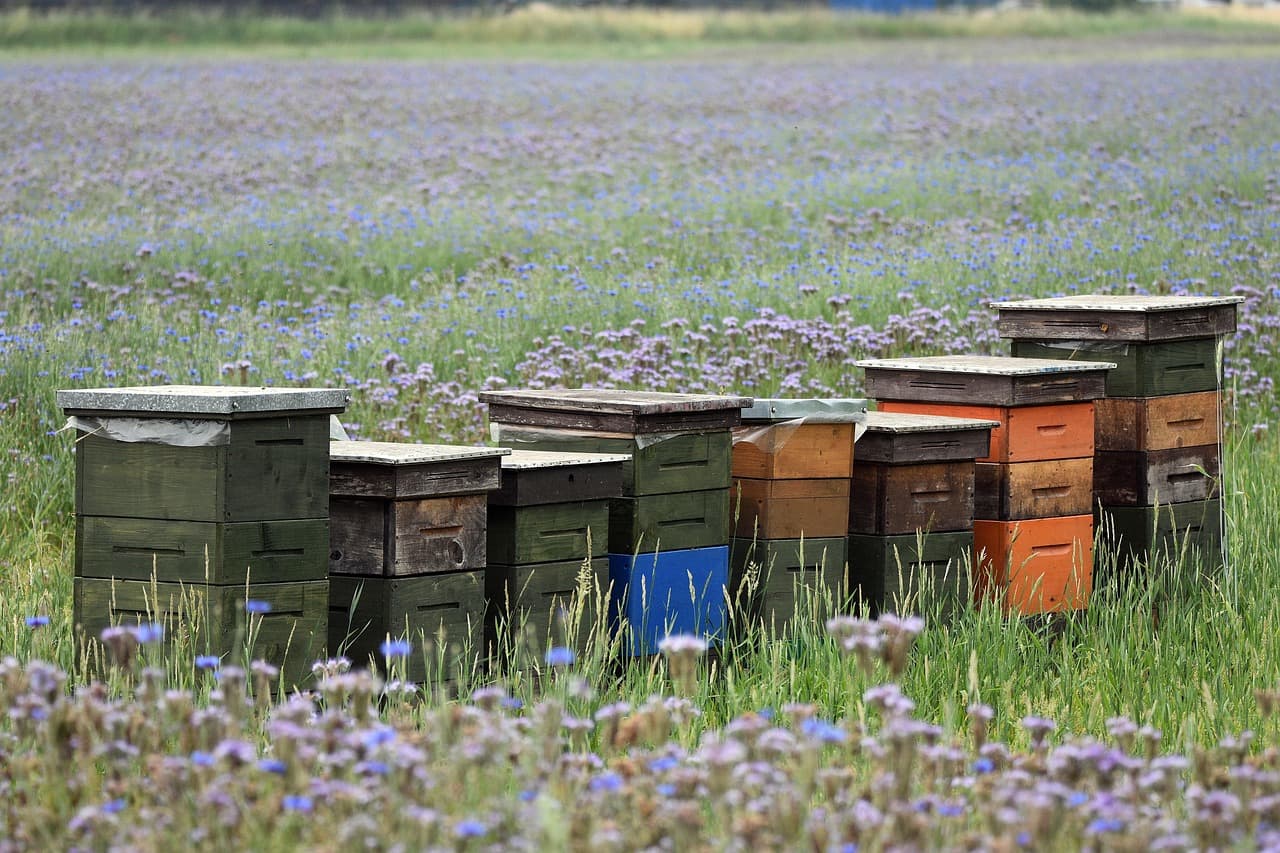
Choosing equipment is the first concrete decision a new beekeeper makes, and it's worth understanding the trade-offs rather than just buying whatever a local supplier stocks.
Hive designs
Langstroth hives are the dominant design in North America and much of the world. They're built around removable vertical frames spaced with a precise "bee space" (roughly 6-9 mm) — a gap small enough that bees won't build comb across it, but large enough that they won't seal it with propolis. That spacing, patented by L.L. Langstroth in 1852, is what makes modern beekeeping practical: frames lift out individually for inspection without destroying comb, boxes stack to expand as the colony grows, and equipment is broadly standardized between suppliers and even between countries.
A Langstroth hive is built from stacked boxes ("supers"), from bottom to top:
- Bottom board — the hive's floor, with an entrance for bees.
- Brood box(es) — the lowest box(es), where the queen lays and the colony's brood nest lives; usually left as the colony's own, unharvested space.
- Queen excluder (optional) — a mesh grid with openings too small for the queen to pass, keeping her out of honey supers so no brood ends up mixed with harvestable honey.
- Honey supers — boxes added above the brood nest specifically for the colony's surplus honey, which is what a keeper harvests.
- Inner cover and outer (telescoping) cover — top layers providing insulation, ventilation, and weatherproofing.
Each box holds a set of standardized frames — thin wooden or plastic rectangles that hold foundation (a thin sheet, often wax or plastic, embossed with a hexagonal pattern) on which bees draw out comb.
Top-bar hives (including the Kenyan and Tanzanian top-bar designs) take a different approach: a single long, usually horizontal box with individual wooden bars laid across the top, from which bees build their own comb downward with no foundation and no surrounding frame. They're cheaper and simpler to build, often preferred where standardized equipment is expensive to source, and some keepers consider the more "natural" comb-building beneficial. The trade-off is that top-bar comb is fragile, cannot be spun in a standard extractor, and isn't interchangeable with boxes from a different hive — each comb is unique to where it was built.
Horizontal hive designs
Both Langstroth and top-bar hives have horizontal variants that expand sideways along a single level rather than upward in stacked boxes — a real ergonomic consideration for a keeper who can't or doesn't want to lift a full deep box, which commonly weighs 36-45 kg (80-100 lb) once full of comb and honey (part of why many keepers deliberately use lighter medium or shallow boxes as honey supers instead, saving deeps for the brood nest):
- Horizontal Langstroth hives ("long hives") use the same standardized Langstroth frames as a stacked vertical hive, just arranged side by side in one long box instead of stacked in boxes on top of each other. This keeps full compatibility with standard Langstroth frames and equipment while avoiding heavy lifting, at the cost of a larger footprint and a hive that's awkward to relocate as a single unit.
- Layens hives are a horizontal design using their own deeper, wider frame size (not interchangeable with Langstroth equipment), popularized in French beekeeping and more recently adopted by some natural/treatment-free beekeepers in North America. The deeper frame gives the colony more comb per frame to overwinter on without needing a second box, but the non-standard frame size means equipment (extractors, spare frames, foundation) generally can't be shared with a Langstroth setup.
Horizontal designs remain a minority choice next to stacked Langstroth, but they're a genuine, growing option worth knowing about — particularly for keepers prioritizing ergonomics over equipment compatibility with the wider beekeeping supply chain.
Insulated poly hives
A more recent equipment shift is material, not shape: poly hives, molded from expanded polystyrene (EPS) rather than built from wood, are increasingly common alongside traditional wooden Langstroth equipment. The main advantage is insulation — poly hive walls typically reach an insulation value of roughly R-6 to R-8 or higher, compared to about R-1 to R-1.2 for standard single-wall wood, a large enough difference that poly hives are often used through cold winters without the extra wrapping a wooden hive needs (covered further in the seasonal-calendar lesson). Poly hives are also generally lighter than an equivalent wooden box despite their thicker walls.
The trade-offs are worth knowing before choosing poly over wood: a higher upfront cost than basic wooden equipment, a softer material that dents or gouges more easily under a careless hive tool or determined rodent, and less tolerance for the flame-scorching sterilization technique traditionally used to disinfect wooden equipment between colonies. Many beekeepers run a mix of both — wood for its familiarity and repairability, poly where insulation matters most (an isolated apiary through a harsh winter, for instance).
Other designs exist beyond these (Warre hives, various regional traditional hives), but Langstroth — in both its standard stacked and horizontal forms — and top-bar cover the large majority of what a new keeper will encounter, and this course focuses primarily on standard Langstroth equipment since it's what most beginner resources, suppliers, and local mentors will assume.
Protective gear
Protective equipment exists on a spectrum, and experienced keepers often wear less than beginners — but a new keeper should start fully covered and lighten up only with experience:
- Veil — covers the face and neck; treated as essential by nearly every keeper regardless of experience level, since facial stings are the hardest to handle calmly.
- Suit or jacket — a full suit (attached veil, covers the whole body) or a separate jacket with a veil; light-colored, smooth fabric is harder for bees to grip and sting through than dark or textured fabric.
- Gloves — leather gauntlet gloves (extending up the forearm) give the most sting protection and are the standard beginner choice. Thin disposable latex, nitrile, or other polymer gloves trade some sting protection for much better dexterity and tactile feedback — useful once a keeper is comfortable enough to want finer control, and their low cost also means a fresh pair is disposable between colonies (a biosecurity habit covered in the pests-and-diseases lesson). Some experienced keepers work bare-handed entirely for maximum dexterity, but that's not a beginner recommendation either way.
- Boots or closed footwear with pant legs tucked or strapped — bees investigate gaps at ankles as readily as anywhere else.
Core tools
- Smoker — burns natural fuel (wood shavings, pine needles, burlap) to produce cool, thick smoke; smoke masks alarm pheromone and triggers a feeding instinct that makes bees calmer and less defensive during an inspection.
- Hive tool — a flat metal pry bar for separating boxes and frames that bees have glued together with propolis, and for scraping burr comb.
- Bee brush — a soft brush for gently moving bees off a frame or a super's edge without crushing them.
None of this equipment needs to be premium to work well. A basic Langstroth setup, a veil and suit, a smoker, and a hive tool are enough to keep a first hive properly — the equipment matters far less than learning to read what the bees are showing you, which the rest of this course covers.
Sources & Further Reading
This lesson paraphrases general equipment and hive-design material from the FAO's beekeeping guidance and the Wikibooks Beekeeping text.
- FAO. Good Beekeeping Practices for Sustainable Apiculture. 2021. Licensed under CC BY 3.0 IGO. https://www.fao.org/documents/card/en/c/cb4923en
- Wikibooks contributors. Beekeeping. Licensed under CC BY-SA 4.0. https://en.wikibooks.org/wiki/Beekeeping
What distinguishes a Langstroth hive from most other designs?
What is the main practical trade-off of a top-bar hive versus a Langstroth hive?
Why might a beekeeper choose an insulated poly (expanded polystyrene) hive over a standard wooden one?
Which piece of protective equipment is most commonly considered non-negotiable for a new beekeeper?