
A Comprehensive Guide to Varroa Mite Treatment and Prevention
Learn how to identify, treat, and prevent varroa mites - the #1 threat to honey bee colonies worldwide.
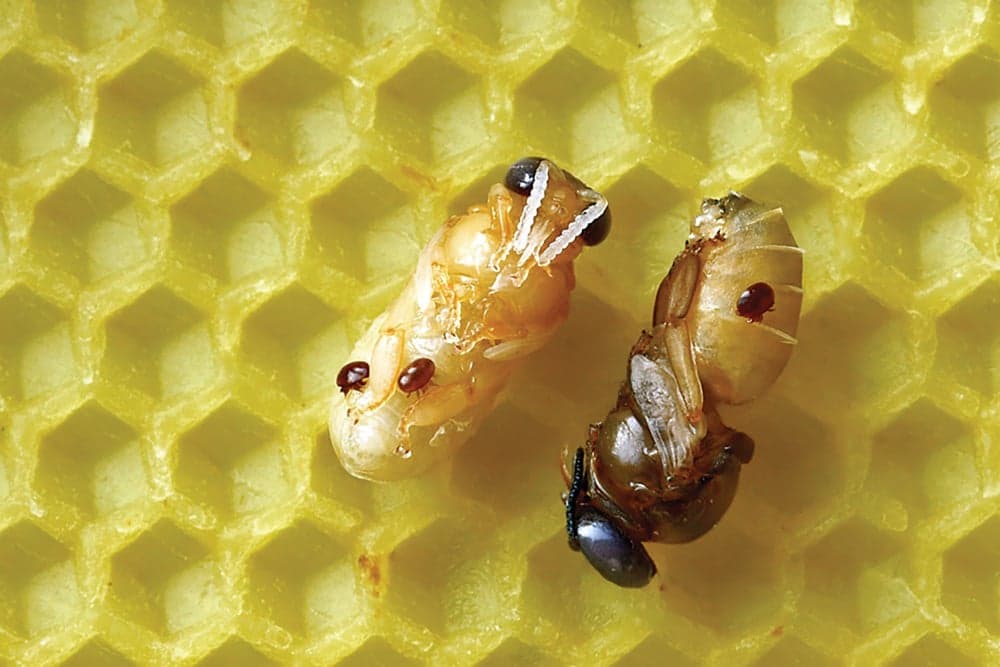
Varroa mites (Varroa destructor) are the most significant threat to honey bee colonies worldwide. These external parasites weaken bees, spread viruses, and can quickly destroy entire colonies if left untreated. This comprehensive guide will help you understand, identify, and effectively manage varroa mites in your apiary.
Understanding Varroa Mites
What Are Varroa Mites?
Varroa mites are small, reddish-brown parasites about the size of a pinhead. They attach to adult bees and reproduce in brood cells, feeding on bee hemolymph (bee blood) and weakening the colony.
Life Cycle
Understanding the varroa life cycle is crucial for effective treatment:
- Phoretic phase: Adult female mites attach to adult bees
- Reproductive phase: Mites enter brood cells before capping
- Reproduction: Mites lay eggs and reproduce in sealed cells
- Emergence: New mites emerge with young bees
Identifying Varroa Mites
Visual Inspection
Look for these signs during hive inspections:
- Mites on bees: Small, brown, crab-like parasites
- Deformed wings: Bees with twisted or shortened wings
- White pupae: Mites prefer drone brood
- Mite drop: Dead mites on bottom boards
Monitoring Methods
Alcohol Wash
- Most accurate method
- Sample 300 (1/2-3/4 cup) bees in alcohol
- Count mites after shaking
Dawn Ultra dish soap
- Non-lethal alternative
- Diluting Dawn Ultra dish soap in water (1-2 tablespoons per gallon)
- Sample 300 (1/2-3/4 cup) bees in solution
- Mites fall through screen
Sugar Roll
- Non-lethal alternative
- Roll bees in powdered sugar
- Mites fall through screen
Sticky Boards
- Place under hive for 24-72 hours
- Count natural mite drop
- Less accurate but useful for monitoring
Treatment Thresholds
When to Treat
Treatment thresholds vary by season:
- Spring: 1-2 mites per 100 bees
- Summer: 2-4 mites per 100 bees
- Fall: 1-2 mites per 100 bees
- Emergency: >10 mites per 100 bees
A great read is from Randy Oliver who has spent countless hours researching the relationship of mites and honeybees: Fighting Varroa & Mite Sampling
Treatment Options
Chemical Treatments
Formic Acid (organic acids)
- Products: Mite Away Quick Strips, Formic Pro
- Timing: Spring through fall
- Pros: Penetrates capped brood, organic approved
- Cons: Temperature sensitive, can harm queens
Oxalic Acid (organic acids)
- Application: Vaporization or dribble method
- Timing: When brood is minimal (late fall/winter)
- Pros: Highly effective, inexpensive
- Cons: Only kills phoretic mites
Amitraz
- Products: Apivar strips
- Timing: Spring or fall
- Pros: Long-lasting, weather resistant
- Cons: Potential for resistance development
Thymol
- Products: Apiguard, ApiLife Var
- Timing: Late summer/early fall
- Pros: Natural essential oil
- Cons: Temperature dependent
Mechanical Methods
Drone Comb Removal
- Remove drone brood during peak mite reproduction
- Effective when combined with other methods
- Labor intensive but chemical-free
Screened Bottom Boards
- Allow natural mite drop
- Improve hive ventilation
- Minimal impact alone but helpful
Brood Breaks
- Create artificial brood breaks
- Interrupts mite reproduction cycle
- Can be achieved through queen caging
Integrated Pest Management (IPM)
Multi-Treatment Approach
Effective varroa management requires multiple strategies:
- Regular monitoring: Track mite levels throughout season
- Rotation of treatments: Prevent resistance development
- Timing coordination: Treat when most effective
- Record keeping: Track treatment efficacy
Seasonal Treatment Schedule
Spring
- Monitor mite levels after winter
- Treat if above threshold
- Consider formic acid or amitraz
Summer
- Continue monitoring
- Drone comb removal
- Prepare for fall treatment
Fall
- Critical treatment period
- Oxalic acid vaporization
- Ensure low mite levels before winter
Winter
- Oxalic acid treatment during broodless period
- Monitor for treatment efficacy
Treatment Safety and Best Practices
Personal Protection
- Wear appropriate protective equipment
- Follow label instructions exactly
- Ensure proper ventilation during application
Bee Safety
- Monitor weather conditions
- Check queen status after treatment
- Ensure adequate ventilation
Honey Safety
- Respect pre-harvest intervals
- Remove honey supers before treatment
- Follow organic certification requirements if applicable
Tracking Treatments with APiLOG
Proper record keeping is essential for effective varroa management:
What to Record
- Mite counts: Before and after treatment
- Treatment type: Product and application method
- Dates: Application and removal dates
- Weather conditions: Temperature and humidity
- Colony response: Queen status, population changes
Using APiLOG for Varroa Management
- Voice notes: Record observations during mite checks
- Treatment tracking: Log all applications and results
- Trend analysis: Monitor mite levels over time
- Reminder system: Schedule follow-up treatments
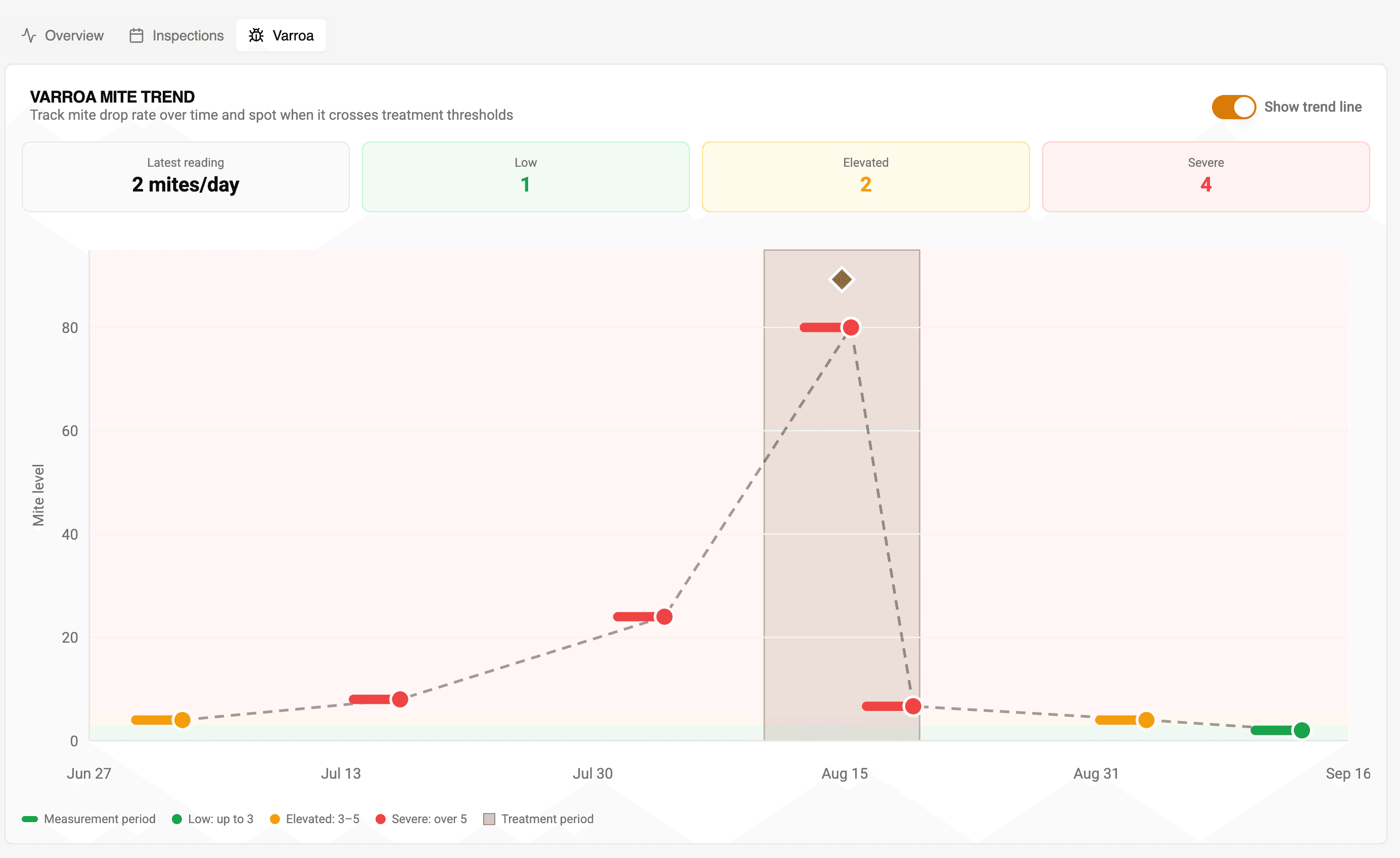
Watch your mite counts, and every treatment, on one timeline
APiLOG's Varroa tab plots each mite reading against your treatment periods, so a spike, a treatment window, and the drop-off that follows all show up on the same chart — no cross-referencing a separate log to see if a treatment actually worked.
Resistance Management
Preventing Resistance
- Rotate treatment types: Use different active ingredients
- Follow label rates: Don't under-dose treatments
- Complete treatment cycles: Finish full application periods
- Monitor efficacy: Test treatment effectiveness
Signs of Resistance
- Treatments become less effective over time
- Mite levels don't decrease after treatment
- Need for more frequent treatments
Natural and Alternative Approaches
Breeding for Resistance
- Varroa Sensitive Hygiene (VSH): Bees that detect and remove infested pupae
- Russian bees: Naturally more resistant to varroa
- Local survivor stock: Bees adapted to local conditions
Essential Oils
- Thymol-based treatments
- Wintergreen and spearmint oils
However research is ongoing for effectiveness
Biotechnical Methods
- Queen trapping during treatment
- Splitting colonies to create brood breaks
- Using small cell foundation (controversial)
Common Treatment Mistakes
Avoid these common errors:
- Treating too late: Waiting until mite levels are too high
- Inconsistent monitoring: Not tracking mite levels regularly
- Poor timing: Treating during honey flows or extreme weather
- Incomplete treatments: Removing strips early or skipping doses
- No follow-up: Not checking treatment efficacy
Emergency Treatment Protocols
High Mite Loads (>10%)
- Immediate treatment: Don't wait for ideal conditions
- Combination approach: Use multiple treatment methods
- Queen protection: Monitor queen health closely
- Follow-up quickly: Recheck mite levels in 2-3 weeks
Late Season Discovery
- Oxalic acid vaporization: Quick-acting treatment
- Formic acid: If weather permits
- Supplemental feeding: Support weakened colonies
- Combine weak colonies: If necessary for survival
Future of Varroa Management
Emerging Technologies
- RNA interference: Targeting mite genes
- Precision breeding: Genetic markers for resistance
- Biological controls: Natural mite predators
- Smart monitoring: Automated mite detection systems
Research Developments
- New treatment formulations
- Improved application methods
- Better understanding of mite biology
- Climate change impacts on treatment timing
Conclusion
Varroa mite management is an ongoing challenge that requires vigilance, proper timing, and accurate record keeping. Success depends on regular monitoring, appropriate treatment selection, and consistent application of integrated pest management principles.
Remember that varroa management is not a one-time event but a continuous process throughout the beekeeping season. By staying informed about the latest research, maintaining detailed records with tools like APiLOG, and working with other beekeepers in your area, you can effectively manage varroa mites and maintain healthy, productive colonies.
The key to success is prevention through regular monitoring and timely intervention. Don't wait until mite levels become critical – proactive management is always more effective than reactive treatment.
Track your varroa treatments and monitor mite levels with APiLOG's comprehensive record-keeping system. Our AI assistant can help you determine optimal treatment timing based on your specific hive data and local conditions.