
ELAP-Ready Colony Loss Reports, Reusable for Insurance Claims
Preparing ELAP reports for hive loss doesn't have to mean a second system. APiLOG turns your dated, per-hive inspection records into a single Colony Loss / Compliance Report — structured for USDA ELAP documentation and reusable for your insurance agent.

ELAP-Ready Colony Loss Reports, Reusable for Insurance Claims
Losing colonies is hard enough without the paperwork that follows — proving what happened, when, and where, to whoever helps you recover. That paperwork usually means documentation for USDA's Emergency Assistance for Livestock, Honeybees, and Farm-Raised Fish Program (ELAP). APiLOG's Colony Loss / Compliance Report turns the inspection records you're already keeping into a single export built for that job: preparing ELAP reports for hive loss, structured for USDA documentation, and the same export you can hand to your insurance agent.
What Goes Into a Colony Loss Report
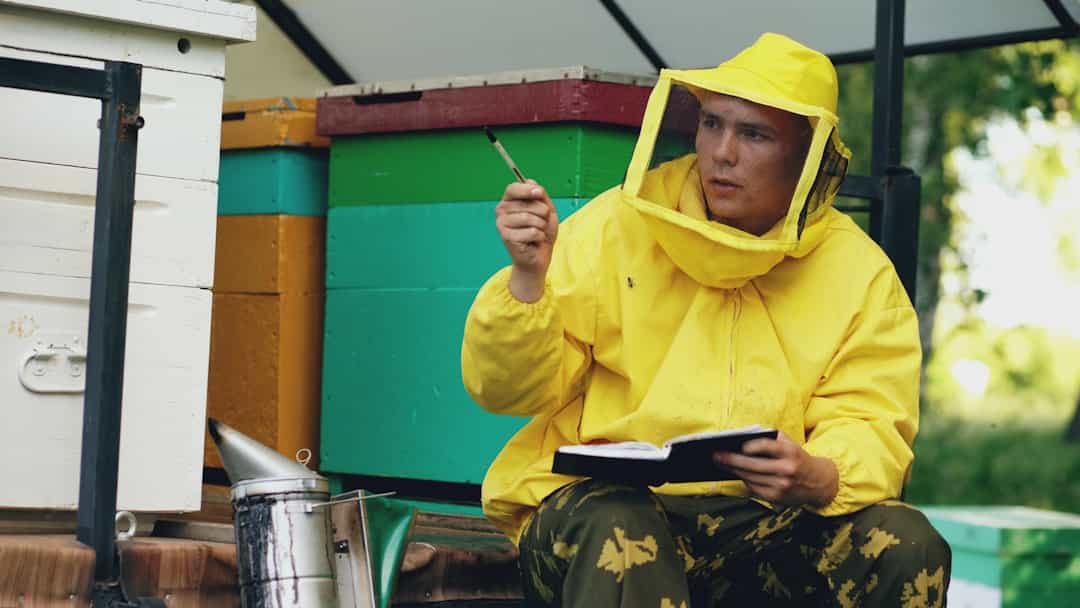
Beekeeper writing dated hive notes in a notebook beside the hives
Nothing about generating a compliance report should mean re-entering data you already logged. Every dated, per-hive record you capture during a normal inspection — colony counts, treatments, and any loss you note in the field — is what the report pulls from. Pick a date range or a specific loss event, and APiLOG assembles it into an export instead of you rebuilding it from memory or a paper notebook.
One Record, Several Uses
A properly dated and located loss record doesn't need to exist twice. The same entry that documents a dead-out for your own history is what an ELAP claim needs, what an insurer asks for, and what a biosecurity authority wants to see — because all three are really asking the same three questions: when did it happen, where, and how many colonies were affected.
ELAP-Ready Exports, Reusable for Insurance Claims
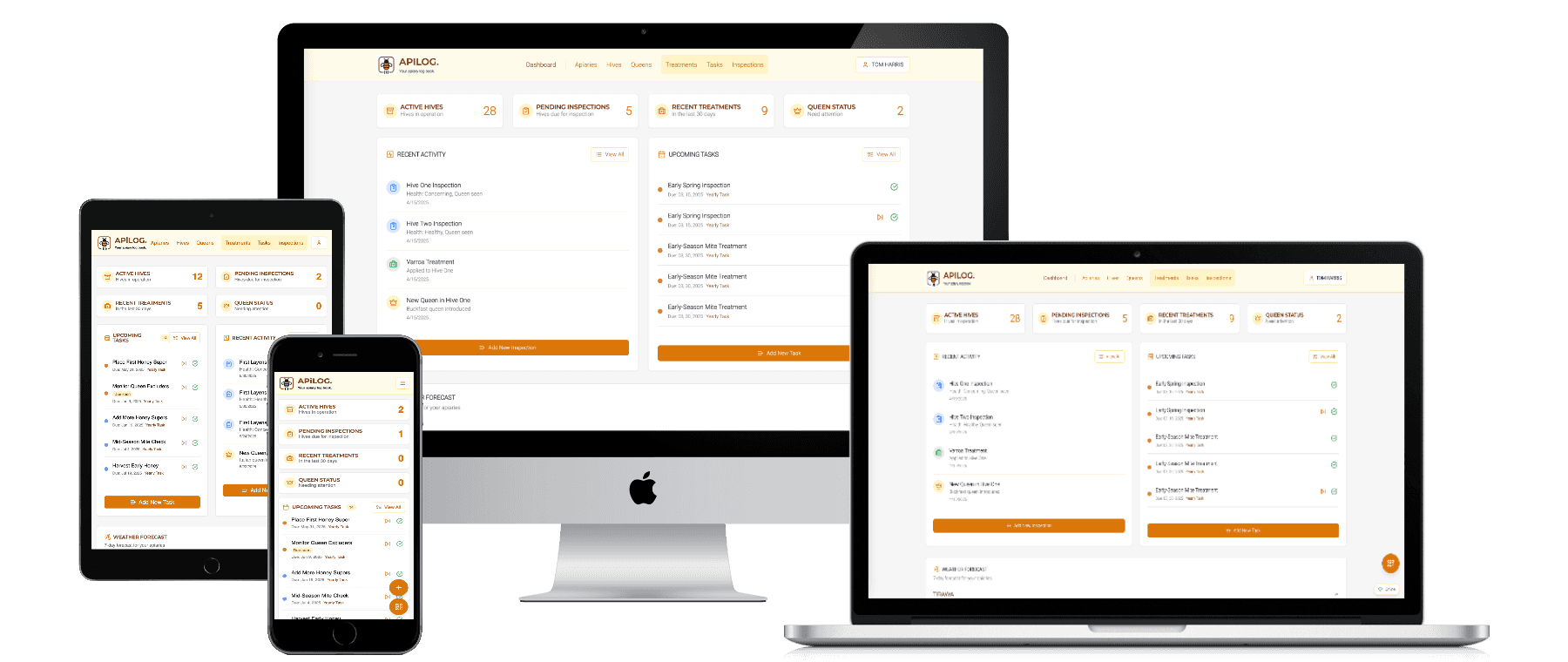
APiLOG dashboard showing hive records across desktop, tablet, and phone
ELAP — the USDA Farm Service Agency's Emergency Assistance for Livestock, Honeybees, and Farm-Raised Fish Program — requires beekeepers to document colony losses with verifiable records before a claim can be considered. We didn't build a separate "insurance module" bolted onto an "ELAP module." We built one export, structured around the documentation ELAP asks for — and because that's close to the same information most insurers want for a claim, the export that's ready for ELAP is also one you can hand straight to your insurance agent.
Built for More Than the U.S.: CFIA and Australian Recordkeeping
Close-up of a hive entrance with bees, the record behind every loss report starts here
Colony loss reporting doesn't look the same everywhere, so we built the export to carry the same dated, per-hive documentation into other regions' recordkeeping — even where the receiving program isn't a single national one.
Canada: CFIA, Provincial Apiarists, and Overwintering Loss Reporting
Beekeeping regulation in Canada is largely provincial — there's no single federal program that mirrors ELAP. The Canadian Food Inspection Agency (CFIA) sets the national biosecurity standard and oversees imports, while colony-loss financial support typically runs through your province's crop/production insurance program, alongside your provincial apiarist. APiLOG's export gives you the same dated, per-hive loss records formatted to support CFIA-aligned biosecurity recordkeeping and whatever documentation your provincial insurer requires — check with your provincial apiarist for the exact form your province expects.
Canadian beekeepers will also recognize the Canadian Association of Professional Apiculturists (CAPA) statement on honey bee wintering losses, compiled annually by CAPA and Provincial Apiarists from a harmonized colony loss and management questionnaire covering overwintering losses, varroa and disease management, and biosecurity practices. It's a survey rather than a claims process, but it's asking for the same underlying record: dated, per-operation wintering loss numbers. APiLOG's export gives you that same data already organized — ready for your provincial apiarist, whether it's headed toward the CAPA survey, a provincial insurance claim, or your own biosecurity records.
Australia: No Single National Program, Same Underlying Records
Australia doesn't run one federal indemnity program for general colony loss the way ELAP works in the U.S. Assistance has instead been outbreak-specific — the varroa mite compensation package coordinated between state and federal governments, and separate state-based American foulbrood compensation funds — alongside the voluntary Australian Honeybee Colony Loss Survey, which tracks losses nationally but isn't a claims process. Because the exact paperwork depends on which state or territory program applies, APiLOG's export gives you the same dated, per-hive loss documentation those programs and the national survey ask for — confirm the specific form with your state department of agriculture or primary industries before you submit.
Setting Up a Colony Loss Report
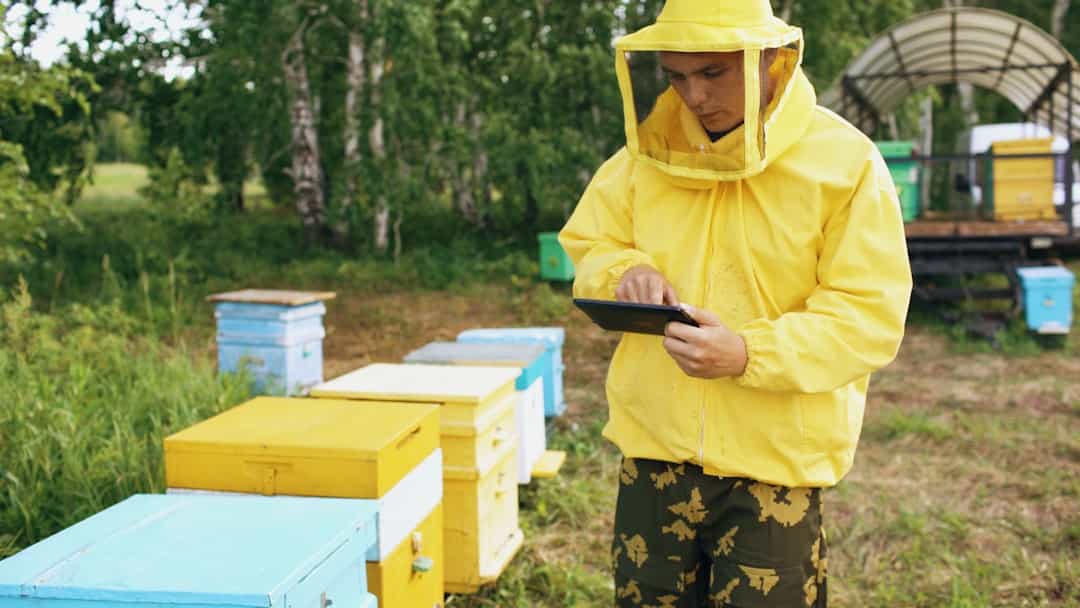
Beekeeper reviewing hive records on a tablet during an inspection
Generating one takes a few clicks: choose the hive or apiary, set a date range or select a specific loss event, and export. The report includes the dates, locations, and colony counts already sitting in your inspection history — ready to submit, or to attach to an email to your insurance agent.
A Note on Regulatory Specifics
Programs, required documentation, and eligibility rules referenced in this post — ELAP, CFIA biosecurity standards, provincial insurance requirements, and Australian state compensation schemes — can vary or change from what's described here. Treat this as a starting point, not a substitute for official guidance, and confirm current requirements with your local regulatory body, provincial apiarist, or insurance agent for claim or submission requirements.
Frequently Asked Questions
What is ELAP?
ELAP is the USDA Farm Service Agency's Emergency Assistance for Livestock, Honeybees, and Farm-Raised Fish Program — it provides financial assistance to beekeepers for qualifying colony losses, provided they're documented with verifiable records.
Can I use the same export for my insurance claim?
Yes. Rather than maintaining a separate insurance report, APiLOG builds one Colony Loss / Compliance Report structured around ELAP-style documentation, which covers most of what an insurance agent asks for too.
Does this work for Canadian beekeepers reporting to CFIA?
The export gives you dated, per-hive records formatted to support CFIA-aligned biosecurity recordkeeping. Since colony-loss financial support in Canada usually runs through provincial insurance programs, confirm the specific submission format with your provincial apiarist.
Can I use this for the CAPA overwintering loss survey?
The Canadian Association of Professional Apiculturists (CAPA) and Provincial Apiarists run an annual wintering loss survey, not a claims process — but it asks for the same dated, per-operation loss numbers your Colony Loss / Compliance Report already provides, making it easy to hand over when your Provincial Apiarist requests it.
Is there an Australian equivalent to ELAP?
Not a single national one. Australian assistance has been outbreak-specific (such as varroa mite and American foulbrood compensation), administered at the state level. APiLOG's export provides the same dated, per-hive loss records those programs and the national colony loss survey ask for.
Got Questions?
I'm an email away if you want help setting up Colony Loss / Compliance Reports for your operation.